


Lives of the Most Eminent Painters, Sculptors & Architects, Volume II
Excerpt from the chapter on Brunelleschi by Giorgio Vasari, first published in 1550.
“Many men are created by nature small in person and in features, who have a mind full of such greatness and a heart of such irresistible vehemence, that if they do not begin difficult—nay, almost impossible—undertakings, and bring them to completion to the marvel of all who behold them, they have never any peace in their lives; and whatsoever work chance puts into their hands, however lowly and base it may be, they give it value and nobility. Wherefore no one should turn up his nose when he encounters people who have not, in their aspect, that primal grace or beauty which nature should give, on his coming into the world, to a man who works at any art, seeing that there is no doubt that beneath the clods of the earth are hidden veins of gold. And very often, in those who are most insignificant in form, there are born so great generosity of mind and so great sincerity of heart, that, if nobility be mingled with these, nothing short of the greatest marvels can be looked for from them, for the reason that they strive to embellish the ugliness of the body with the beauty of the intellect; as it is clearly seen in Filippo di Ser Brunellesco, who was no less insignificant in person than Messer Forese da Rabatta and Giotto, but so lofty in intellect that it can be truly said that he was sent to us by Heaven in order to give new form to architecture, which had been out of mind for hundreds of years; for the men of those times had spent much treasure to no purpose, making buildings without order, with bad method, with sorry design, with most strange inventions, with most ungraceful grace, and with even worse ornament. And Heaven ordained, since the earth had been for so many years without any supreme mind or divine spirit, that Filippo should bequeath to the world the greatest, the most lofty, and the most beautiful building that was ever made in modern times, or even in those of the ancients, proving that the talent of the Tuscan craftsmen, although lost, was not therefore dead. Heaven adorned him, moreover, with the best virtues, among which was that of kindliness, so that no man was ever more benign or more amiable than he. In judgment he was free from passion, and when he saw worth and merit in others he would sacrifice his own advantage and the interest of his friends. He knew himself, he shared the benefit of his own talent with many, and he was ever succouring his neighbour in his necessities. He declared himself a capital enemy of vice, and a friend of those who practised virtue. He never spent his time uselessly, but would labour to meet the needs of others, either by himself or by the agency of other men; and he would visit his friends on foot and ever succour them.”
Giorgio Vasari, Lives of the Most Eminent Painters, Sculptors & Architects, Volume II (1550), pg 196.
Translation by: Gaston du C. De Vere (1912-1915)
Featured Images:
- Florence Cathedral, completed by 1436 with a dome engineered by Filippo Brunelleschi
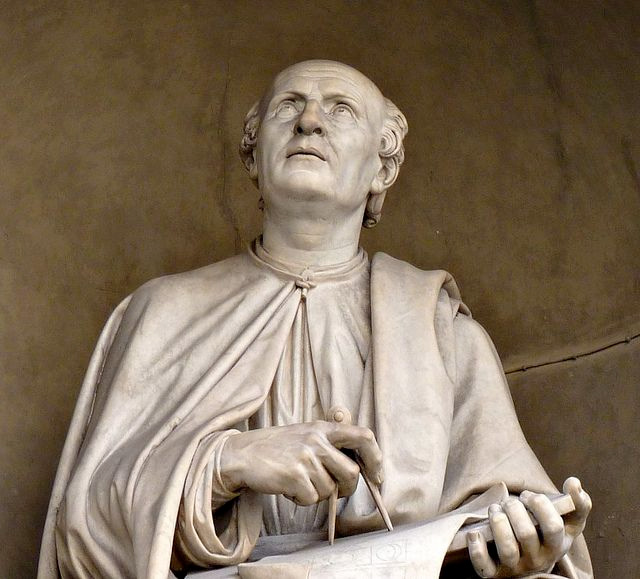
- Portrait of Brunelleschi statue by Luigi Pampaloni, 1830; near the Duomo, Florence.