


As LACMA continues the final phases of its multi-years-long renovation, I can still envision Natalia Goncharova’s Archangel Michael (1910) where it long hung in the now demolished Ahmanson Building, overlooking Tony Smith’s explosive black sculpture, Smoke. Goncharova’s fiery portrait is a manifesto, re-envisioning traditional religious imagery with the visual intensity of Russian icon painting filtered through the radical aesthetics of early twentieth-century modernism. The composition is resplendent with warm colors—rich caramels, burnt orange, and scarlet red—capturing a dramatic moment of St. Michael as the triumphant heavenly warrior. The celestial warrior rides confidently forward, a directly reference to Revelation 12:7-9, portraying Saint Michael leading God’s army against the dragon in the apocalyptic battle between good and evil. Goncharova’s brilliant rendition captures the raw energy of the Russian avant-garde at the dawn of the 20th century while seeming to predict the social unrest that would unfurl less than a decade later with the 1917 Revolution.
The painting pulses with symbolic meaning drawn from traditional Byzantine and Russian religious art. Michael, whose name means “Who is like God?,” appears as heaven’s champion, the angel who cast Satan from Paradise. Goncharova depicts him in traditional warrior garb, but her treatment transforms conventional representation through her distinctive fusion of Neo-Primitivism, Cubo-Futurism, and folk art influences. The bold outlines and simplified forms recall lubok—Russian popular prints—while the spatial compression and fractured planes show her engagement with Cubism. While just three years later, Goncharova would famously declare, “I have passed through all that the West can offer… I now shake the dust from my feet and distance myself from the West,” the bold style here suggests her feet may still have borne some of that Parisian soot.
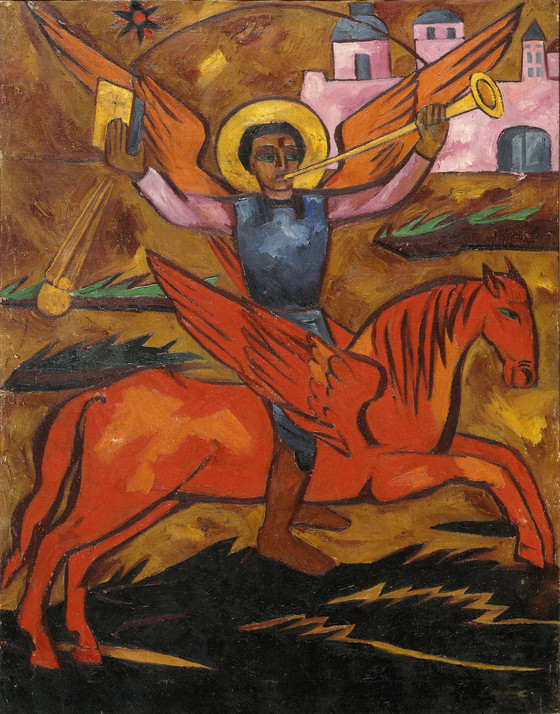
Returning to the composition, the archangel astride a red winged horse dominates the composition, his figure rendered in bold, flattened planes of color that reject Western perspective—as the Cubists had done—in favor of the spiritual symbolism of the Orthodox tradition. His own arms and wings spread wide, gospels in one hand and a trumpet in the other, symbolizing the divine message and angelic call to heaven at the Last Judgment or the Second Coming of Christ, drawn from passages like Matthew 24:31 (“He will send his angels with a loud trumpet call”) and 1 Thessalonians 4:16 (“For the Lord himself will come down from heaven, with a loud command, with the voice of the archangel and with the trumpet call of God”). Goncharova’s portrayal of sacred themes was neither traditional nor ironic, it provided a means for the artist to connect with Russian culture and the spiritual tradition they represented while dramatically recasting it in modern attire.
Color becomes both descriptive and symbolic. Rich reds and golds evoke the jeweled tones of icon painting, where pigments carried theological significance. Gold, in particular, represented divine light, the pure energy of God made visible. Goncharova’s application of color, however, is distinctly modern—applied in thick, visible brushstrokes with bold patches of saturated hues that emphasize the painting’s surface rather than creating illusionistic depth. This technique paradoxically honors the icon tradition where the flat surface was understood as a window to the divine realm rather than a representation of earthly space while also appearing quintessentially modern.
Goncharova was a pioneering figure in the Russian avant-garde, achieving fame alongside her partner Mikhail Larionov. It was, in fact, Larinov who encouraged her to abandon sculpture for painting, as he once proclaimed, “Yours is an eye for color, but you are too preoccupied with form. Open your eyes to see your own eyes!” Together they explored the faceted forms of modernism through many different visions and co-founded Rayonism and the couple’s interests ranged widely from there, from Neo-Primitivism to stage design for Diaghilev’s Ballets Russes. While her work may hint at the coming trauma of revolution, neither she nor her partner would experience it firsthand, what began as a short stay in Paris to work with fellow Russian Diaghilev led to her permanent residence as revolution broke out. Her many colleagues back home, at first partnered with the new government, would later be widely suppressed and replaced by the official state style of Socialist Realism.
Looking back to the vitality of her early experimental techniques, her willingness to draw on Russian folk traditions and religious imagery, combining them with modernist formal innovations, helped define a distinctly Russian contribution to twentieth-century art. A visual language that once thrived, was later suppressed and rediscovered over the course of the long 20th century. The dynamic composition, portraying Archangel Michael on his fiery red steed, demonstrates how traditional symbols could, and still can, be revitalized through new visual languages. The result bridges centuries past and present, making ancient symbols speak with renewed contemporary urgency.