


The Rococo is often dismissed as the “decadent art of the aristocratic elite,” and sure, there’s definitely some truth to that. But this era of painting can also be recognized for achieving something far more interesting than portraying rich folk in their satins and silks. Instead of pulling a Diderot and dismissing the extravagance of this era, we can recognize what was achieved. Rather than commissioning monumental works glorifying the monarchy, church, and state, Rococo patrons—wealthy aristocrats, financiers, and the emerging bourgeoisie—wanted something different, something more contemporary. As they commissioned paintings for their newly built private salons and townhouses in the lavish and light Rococo style, they wanted paintings that equally reflected their personal tastes rather than public propaganda. In other words, this wasn’t just a stylistic change; it represented a fundamental reimagining of the kinds of stories art might tell.
Enter Watteau
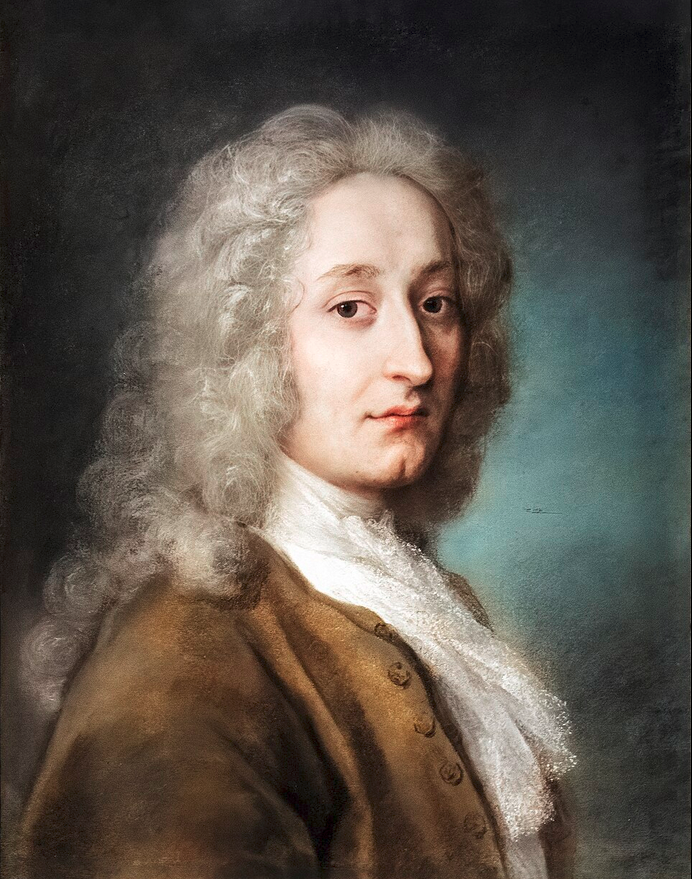
Jean-Antoine Watteau was born in 1684, in the northern border town of Valenciennes, to a reasonably well-off family—though not one with any artistic leanings, and therefore his earliest training remains a bit obscure. In 1702, at age 18, he moved to Paris where he began to sell small sketches and copies of popular genre paintings. As it turns out, he was at the right place at the right time. He came into contact with Claude Gillot, who furthered Watteau’s painting technique, introduced him to theatrical subjects and commedia dell’arte characters, and had a real artistic influence on his development. It was during this time he also met Claude Audran III, a popular interior designer and decorator, for whom he later worked.
His popularity and connections brought him into the circle of the Académie royale de peinture et de sculpture (The French Royal Academy of Painting and Sculpture) where he first submitted, unsuccessfully, for the Prix de Rome in 1709 (he won second place). He never went on to win the Prix de Rome but continued to rise in popularity even without the prestigious pedigree. A few years later, Watteau was sponsored by the great decorative painter Charles de La Fosse, known for his colorful murals at Versailles, for admission into the academy in 1712. The only requirement? Submit his reception piece. But as days turned to weeks to months to… literally years and still no painting, the academicians grew impatient.
To be clear, the delay wasn’t entirely Watteau’s fault. He’d been approved to submit the work back in 1712, but private commissions kept rolling in as his reputation grew. By the time he finally delivered the painting in 1717, he’d created something that would define an entire movement—even if that wasn’t exactly his intention. The painting, The Pilgrimage to the Island of Cythera, now hangs in the Louvre, where a placard notes it as one of his masterpieces. What it doesn’t quite capture is how radical this painting was for its time.
A Quick Look
Watteau’s Pilgrimage offers a playful mashup of past and present, bringing together the lofty themes of ancient myth with the decadence of the contemporary aristocracy. At left, there’s a boat—a sort of grandiose gondola—docked at the shore, steered by a pair of scantily clad oarsmen with a gaggle of putti—those chubby winged babies symbolizing love—flying overhead. The lavishly dressed couples meander from the shoreline deeper into the lush vegetation of the island. The further inland they go, the more intimate the relationships seem to become. In addition to their refined attire, the men carry tall walking staffs and wear short capes around their shoulders, the traditional garb of pilgrims. At the far right sits a couple with a small child curiously sitting on a quiver full of arrows, tugging on the woman’s dress. They’re positioned next to a partially broken ancient statue of a female nude, draped with roses, with another quiver of arrows wrapped around its base. For Watteau’s audience, the message was clear: the statue is Venus, making the child a thinly veiled allusion to Cupid. The island of Cythera also happens to be her mythological birthplace.

A new kind of pilgrimage
Watteau’s nod to “the pilgrim” is more than incidental—it’s the essential clue that solves the puzzle of this painting. It’s an element easily overlooked today; not many contemporary viewers recognize the iconography of religious pilgrimage in those staffs and capes worn on a journey to a sacred site. Watteau took the visual language of religious devotion and applied it to an entirely different type of journey. These aren’t figures from medieval Europe nor ancient Greece, but the aristocracy of the early 18th century, donning powdered wigs, silk gowns, and embroidered coats painted in with the feathery brushwork typical of Watteau.
The pilgrimage theme, however, would have resonated with Watteau’s contemporaries. The reframing of the pilgrimage may have been inspired by the 1705 opéra-ballet La Vénitienne (The Venetian Woman), which featured a voyage to Cythera alongside commedia dell’arte characters—the two subjects Watteau would pursue throughout his career. Venetian culture was having a moment during the Regency period. After the death of Louis XIV and his rigid, formal court, French aristocrats were obsessed with all things Venetian: the carnival culture, the theatrical spectacle, the sensuality, and especially that gorgeous Venetian use of color and light. The gondola in Watteau’s painting isn’t just decorative—it’s a nod to this fashionable infatuation with La Serenissima.* The pilgrimage isn’t to a cathedral. It’s to love itself, to pleasure, to the kind of intimate romantic encounters that happen in garden grottos and private salons.
Although greatly popular, the theme of the painting presented a bit of a conundrum. It referenced elements of classical mythology and was of a relatively large scale, but was not set in the distant past like traditional history painting demanded. The Venus portrayed was not an actual goddess from a well-known myth but a timeworn statue. Nor was it purely genre painting offering morality dressed in the simple narratives of everyday life. Instead, it existed in a kind of liminal space not yet defined, but one that soon would be.
Defining the Fete Galante
In many ways, The Pilgrimage to the Island of Cythera sets the stage for what the Rococo would become. The soft pastels—those pale blues, rose pinks, golden ambers—define the movement’s color palette. The feathery brushwork, visible in the shimmering fabrics and atmospheric landscape, updates the lavish technique of Rubens with a lighter, more delicate twist. The subject matter elevated pleasure and sensuality over moral instruction, and this was just the beginning…just wait until we meet Boucher and Fragonard!
The Academy didn’t quite know what to do with this painting. It didn’t fit into any established category in the academic hierarchy. History painting portrayed grand historical or mythological scenes. Genre painting showed everyday life with moral lessons. But this was something new. When Watteau finally submitted the painting in 1717, the Academy invented a new classification just for him: “fête galantes“—elegant outdoor entertainments where aristocrats engage in courtship and pleasure. Watteau became the first and defining painter of this new genre, one that would be imitated but never quite matched.
But for all the frivolity it seems to display, the attitude of the Rococo marked a new kind of patron: paintings for the salon culture that reflected the wit, wealth, and sensuality marking the return of the aristocracy to Paris and the new social liberties of the Regency period. Made for intimate gatherings and private enjoyment, for an aristocracy less interested in grand allegorical narratives who wanted to see themselves—or idealized versions of themselves—engaged in sophisticated leisure. However, Watteau wasn’t inventing entirely from scratch. The Venetian Renaissance painters—Giorgione and Titian—had created similar scenes in their fête champêtre (rural feast) over two centuries earlier, paintings that showed contemporary aristocrats in idealized pastoral settings. Watteau would have studied Titian’s Pastoral Concert in the royal collection at the Palais du Luxembourg, where Audran worked as curator. But where the Venetians mixed contemporary figures with allegorical nudes and classical themes, Watteau made his scenes entirely contemporary, entirely French, entirely about the pleasures of his own moment. He took Venice’s mastery of color, light, and leisure—already trendy in Regency Paris—and transformed it into something new.
As One Journey Ends
With The Pilgrimage, Watteau established a framework where contemporary life could be rendered through the lens of mythology without becoming either pure allegory or pure documentation. The aristocracy could see themselves as participants in an eternal romance, their garden parties elevated to the status of classical myth. The Academy’s invention of the “fête galante” category acknowledged something they probably didn’t want to admit: art didn’t have to glorify the state or instruct the faithful. It could simply capture pleasure, beauty, intimacy—the things people actually wanted on the walls of their townhouses and salons.
The Rococo may be decadent, but The Pilgrimage to the Island of Cythera reveals what drove that shift. Rather than commissioning monuments to royal power or distant biblical scenes, the aristocracy wanted reflections of their own world—their refined sensibilities, their sophisticated pleasures, their contemporary lives rendered as beautifully as any myth. Watteau, in a career cut tragically short, dying at age 37 of tuberculosis, set the course for others to follow.
*La Serenissima: “The Most Serene,” the poetic nickname for the Republic of Venice.