


Elisabeth Vigée Le Brun’s gift for capturing aristocratic elegance while imbuing her subjects with warmth and psychological presence finds exquisite expression in her Portrait of Theresia, Countess Kinsky. The Countess gazes directly at the viewer, a commanding presence in the 18th-century galleries of the Norton Simon Museum of Art in Pasadena. Her expression a balance of formal decorum and intimacy—the signature quality that made Vigée Le Brun the most sought-after portraitist in pre-Revolutionary France and throughout Europe during the years of her exile. Dressed in a symphony of blue and gold, from the golden headdress to the deep Prussian blue of her gown, the sumptuous fabrics embody refinement and position. Yet something in her direct gaze suggests an individual and her sorrowful legacy rather than merely a symbol of rank.
The iconography speaks the language of eighteenth-century portraiture, where every detail carries social meaning. Her costume, rendered with Vigée Le Brun’s characteristic attention to textile surfaces, demonstrates both wealth and taste and signals her status and cultivation. Yet the artist avoids the rigid formality that could make such portraits feel like mere inventories of luxury goods. The Countess’s long brunette hair cascades, windswept, down her back and cheeks reddened by the exercise of an afternoon stroll. Vigée Le Brun’s cultivated, soft brushwork and subtle color transitions—particularly in the treatment of skin tones—create a sense of her subject’s living presence.
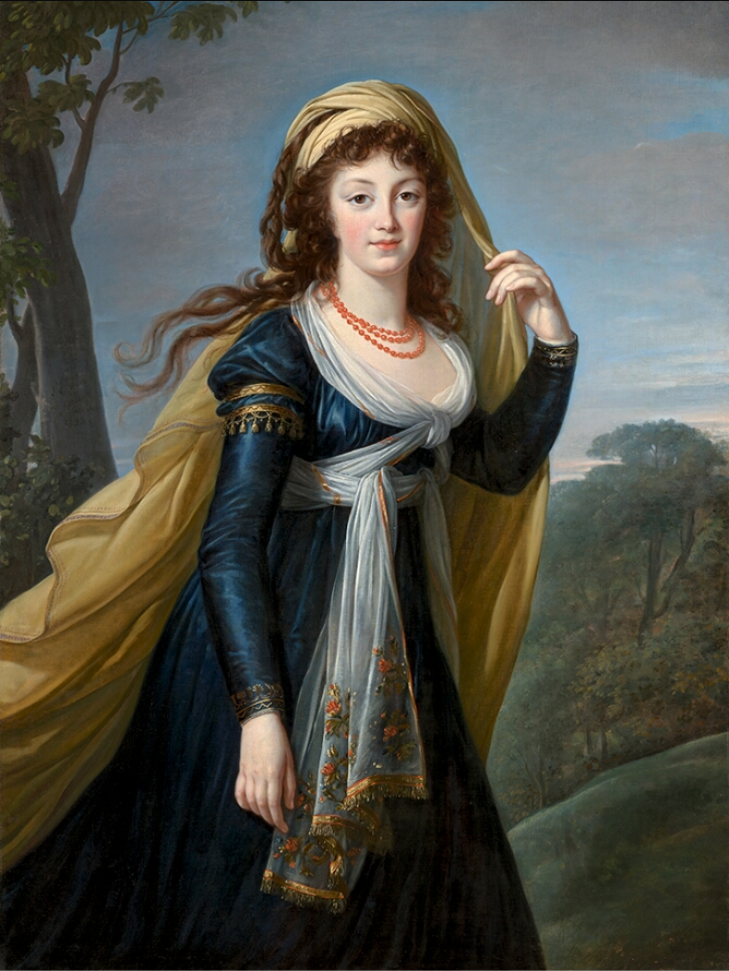
Elisabeth Louise Vigée-LeBrun, Oil on canvas, 54 x 39 inches
Light becomes a crucial symbolic element, illuminating the Countess’s face and décolletage while allowing hazy atmospheric effects to fade into the background, defining the compositional depth. This careful manipulation of light and shadow, learned from studying Rubens and other Flemish masters, gives the portrait its sculptural quality while maintaining a delicacy appropriate to the subject. The fertile landscape in the background, kept deliberately simple and atmospheric, complements, yet ensures that attention remains focused on the sitter herself.
Vigée Le Brun’s own story adds another dimension to viewing this work. As a woman painter who achieved remarkable success in a male-dominated field, she navigated complex social and professional terrain with the same grace her portraits embody. She was admitted to the Académie Royale in 1783—the same year as her rival, Adelaide Labille-Guiard, who also served the royal court—one of only fifteen women ever granted this honor. When the French Revolution erupted, she fled France, spending twelve years traveling through Europe’s courts, painting royalty and aristocrats wherever she went.
Vigée Le Brun’s exile became an extraordinary odyssey across Europe. Fleeing France with her daughter in October 1789, she first traveled to Italy, where she spent three years moving between Rome, Naples, and other cities, absorbing the works of the Old Masters and securing commissions from Italian aristocracy and the exiled French nobility. In 1792, she moved to Vienna, where she would remain for nearly three years, painting members of the Austrian court and aristocracy—including the captivating Countess Kinsky, whom she encountered in the salons of Viennese society.
The Countess, a renowned beauty nicknamed “La Céleste Thérèse,” had become the object of Emperor Leopold II’s infatuation, leading to a hastily arranged marriage to Count Kinsky to prevent social scandal. As described on the Norton Simon Museum of Art’s didactics, her husband abandoned her almost immediately following the ceremony, returning to his mistress. The union, though dissolved the following year, left both parties bound for years to come. When Vigée Le Brun painted this portrait in 1793, the Countess remained trapped in this liminal state—neither married nor free—a predicament that would endure until 1807, when the Vatican finally annulled the marriage, allowing her at last to wed the man she had come to love. It was during this period of enforced waiting, her beauty and grace shadowed by circumstances beyond her control, that Vigée Le Brun created this haunting portrait.
From Vienna, Vigée Le Brun traveled to Russia in 1795, where she would spend six years—her longest stay during exile—painting portraits of Catherine the Great’s family and Russian nobility in Saint Petersburg and Moscow, earning substantial fees that allowed her to maintain her lifestyle until she finally returned to France during the reign of Napoleon, but that’s a story for another day!