


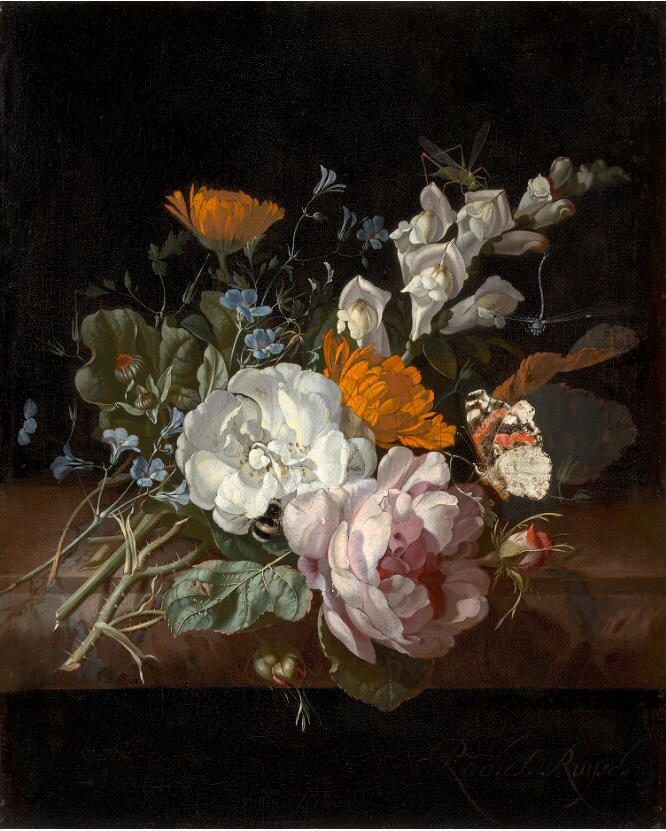
Rachel Ruysch’s exquisite Nosegay on a Marble Plinth, nestled in the permanent collection of the Norton Simon, quietly beckons the viewer with its seemingly effortless arrangement of botanical brilliance. Against a darkened background, a small bouquet of flowers are together precariously positioned on the edge of a marble counter. A pair of roses unfurl their delicate petals back-grounded by brilliant orange daisies and wild flowers. On closer view, a trio of insects traverse the composition—a dragonfly hovers mid-flight, a butterfly is perched on a loose leaf, while a grasshopper menaces from above. The painting operates as both visual feast and symbolic meditation on time, beauty, and the natural world.
The tradition of Dutch floral still life was already well-established when Ruysch began painting in the late seventeenth century, and Ruysch’s deft handling of theme weaves together the expected botanical accuracy combined with a rhythmic virtuosity. Each bloom is rendered with near scientific precision, yet arranged with an artist’s eye for color harmony and visual coherence. The nosegay—a small bouquet of flowers—were carefully chosen arrangements with specific blooms that each held their own symbolic value, as did the curated species of insects that lingered close by.
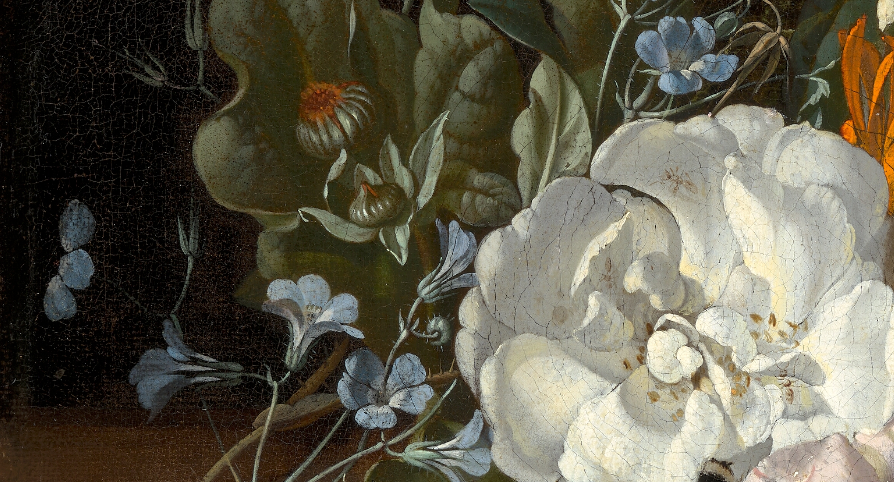
While today, the meanings associated with different species of flowers might not be commonly known, in early modern European art these blooms had widely recognized symbolic values that communicated additional meaning. Reading this meaning went by the curious name of tussie-mussie, derived from the Middle English “tuse” (knot of flowers) and “mose” (moss to keep stems fresh). The combination here—of roses, daisies, white snapdragons, and small blue wildflowers, possibly forget-me-nots—formed a declaration of steadfast courtship: love that endures (forget-me-nots and roses), innocence and loyalty (daisies), offered with gentle fidelity and virtue (white snapdragons), suitable for suitors in Dutch or Elizabethan circles to send their beloved.
Yet equally embedded within this lush display lies the vanitas tradition, that particularly Dutch preoccupation with mortality and the fleeting nature of earthly pleasures. The flowers, captured at various stages of bloom, remind viewers that beauty is transient. A rose at peak perfection will soon shed its petals; the morning glory lives but a single day. The trio of insects bring another layer of meaning to the declaration of love, the grasshopper, the nemesis of many a gardener, offers a warning against idleness; the dragonfly echoes the flowers warning of life’s brevity, and the butterfly who transcends the earthly perils symbolizes transcendence over earthly foibles. Together, they reinforce the message of memento mori: beauty fades, pleasures pass, but spiritual renewal endures.
The marble plinth introduces another symbolic register. Its cool, enduring stone contrasts with the organic softness of the flowers, suggesting the tension between eternal and temporal, amplified by the butterfly—symbolizing the transience of life, the fragility of beauty, and the resurrection of the human soul. Small water droplets catch the light on leaf surfaces—a technical tour de force that demonstrates Ruysch’s observational skills (as if another was needed) while symbolizing life’s vital essence. Yet Ruysch’s technical mastery performs a kind of alchemy, preserving these ephemeral moments in pigment and oil, creating a permanence that nature itself cannot offer. She captures the ever-present dichotomy of the still life tradition, which preserves the very message of brevity it seeks to convey.
Ruysch enjoyed a remarkable career that was anything but ephemeral, spanning nearly seven decades, an extraordinary achievement for any artist, particularly a woman in the seventeenth and eighteenth centuries. She commanded high prices for her work and served as court painter to Johann Wilhelm II, Elector Palatine of the Rhine. Her paintings were sought after across Europe, testament to both her technical brilliance and the enduring appeal of her symbolic vocabulary. In Nosegay on a Marble Plinth, that vocabulary speaks eloquently of beauty’s fragility and art’s capacity to transcend time’s relentless march.