


18th century 18th century art 19th century 19th century art 20th century 20th century art Abstract Painting aestheticism archive art history art in LA avant garde British Artists contemporary art Critic's Picks english art Features french art French Artists History Painting Impressionism Jim Shaw Light & Space Light and Space Manifestos Mark Ryden Mixed media museum exhibitions museums on view Painting photography Pop culture Post-painterly abstraction primary source Primary Sources printmaking Public Art realism Reports Rococo Roland Reiss Sculpture Top 10 Women artists
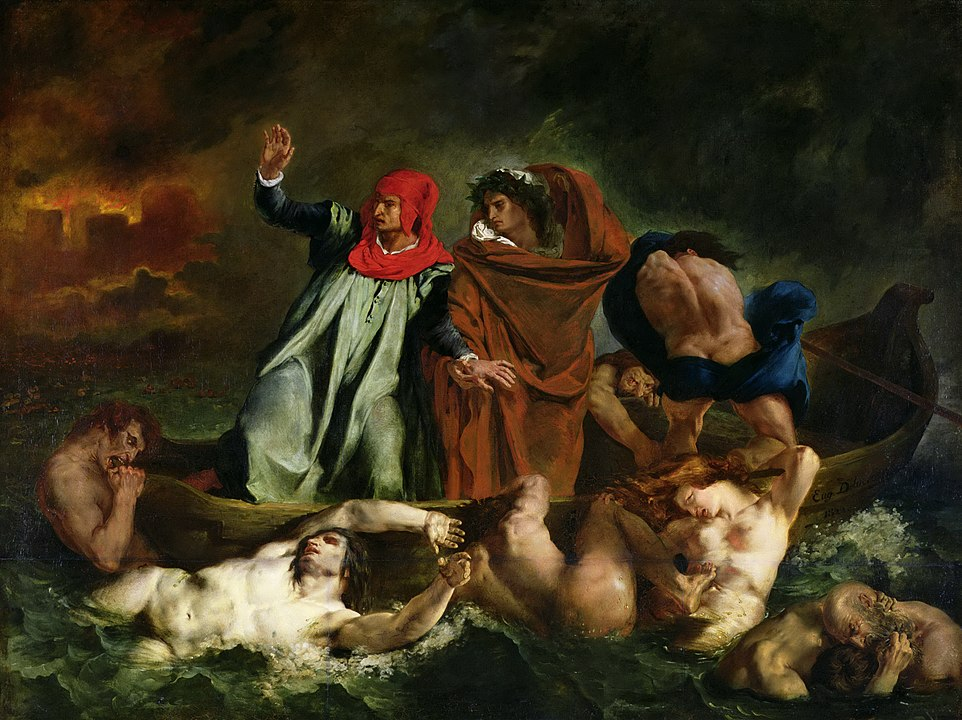
An unusual painting caught viewers’ eyes at the Paris Salon of 1822. A small boat holding two passengers slowly makes its way through stormy waters by the strained efforts of a Herculean oarsman with his back to the audience. Seven figures thrash in the dark waters of the river Styx, some nearly submerged, others clawing desperately at the small craft, threatening to drag it down. Standing aboard are Dante—cloaked in a red hood—who recoils in horror at the scene unfolding around him and his guide Virgil steadies him. It is a gesture both literal and symbolic: reason attempting to anchor emotion in the face of overwhelming chaos. This is The Barque of Dante, the first painting the young Eugène Delacroix would submit to the Salon when he was twenty-four years old and virtually unknown.
The canvas measures approximately six-by-eight feet, large enough to command physical presence in a gallery space, impossible to ignore. It depicts a scene from the eighth canto of Dante’s Inferno—the crossing of the Styx, which separates the upper levels of Hell from the deeper circles below. The river holds the souls of the wrathful, those who surrendered to anger and resentment in life and now face eternal consequences. Delacroix captures the moment when these damned souls recognize Dante as a living person and surge toward him. As Dante wrote in the Inferno: “As soon as my guide and I were in the craft, the ancient prow went on, and cut deeper into the water, than it did with other passengers.” The boat sinks lower under the weight of its unusual cargo—a living soul traveling through the realm of the dead.
Yet neither Géricault nor Delacroix entirely abandoned their classical training—the figures retain a sculptural solidity, muscular anatomies that recall ancient statuary even as they’re deployed for decidedly non-classical narratives
Delacroix had trained in the studio of Pierre-Narcisse Guérin, himself a celebrated pupil of the icon of French painting, Jacques-Louis David. The education was thoroughly classical: drawing, composition, the primacy of line over color, restraint over expression. But Delacroix was drawn to different models. He studied the Venetian masters, particularly Titian and Rubens, whose rich color and dynamic brushwork suggested possibilities his Neoclassical instructors would have dismissed as undisciplined. More significantly, he had met Théodore Géricault in Guérin’s studio—seven years his senior, then at work on A Shipwreck Scene, better known today as the notorious The Raft of the Medusa, which had scandalized Paris audiences in 1819 with its unflinching depiction of suffering and death with equally unsettling political nuance. The influence is unmistakable as both paintings show desperate figures struggling for survival in dark waters. Yet neither Géricault nor Delacroix entirely abandoned their classical training—the figures retain a sculptural solidity, muscular anatomies that recall ancient statuary even as they’re deployed for decidedly non-classical narratives. What changed, however, was the emotional register, the subjects chosen, and the artist’s willingness to depict raw suffering and fear rather than idealized heroism.
When The Barque of Dante appeared at the Salon of 1822, critical response divided sharply. Some praised its emotional power, its technical boldness. Others condemned it as crude, melodramatic, lacking the refinement expected of serious history painting. But the painting achieved what Delacroix needed: it announced his arrival. Two years later, The Massacre at Chios would win him a gold medal and establish him as a leading voice of French Romanticism, arriving just months after Géricault’s untimely death. This vision of hell marked the beginning of a career built on the principle that feeling mattered more than form, that individual experience trumped universal ideals of logic and order.
The subject itself represented a deliberate expansion of acceptable source material for history painting. Where Neoclassical artists looked almost exclusively to Greco-Roman antiquity, Delacroix turned to medieval Italian literature. Dante Alighieri had lived through a period of violent political upheaval in Florence, was exiled on charges of corruption by opposing factions, and wrote The Divine Comedy during that exile—an epic poem describing an imagined journey through Hell, Purgatory, and Paradise as a metaphoric path toward salvation. The poem was personal, subjective, structured around Dante’s own emotional and spiritual transformation. This made it perfect material for Delacroix’s imaginative, Romantic interpretation.
The scene Delacroix chose to paint comes laden with allegorical weight. Dante, overwhelmed by what he witnesses, represents raw human emotion confronting life’s horrors. Virgil—the Roman poet who serves as his guide through Hell—embodies reason, wisdom, classical virtue. Notice that Virgil doesn’t shield Dante from the experience; he guides him through it. Reason doesn’t suppress emotion in this formulation; it directs it, providing stability when instinct threatens to overwhelm. Most of the souls Delacroix depicts are generic representations of the wrathful, but one carries specific historical significance: Filippo Argenti, a political enemy of Dante’s from Florence. The recognition adds another layer—this isn’t abstract moral allegory but personal reckoning, the poet confronting someone who wronged him, now suffering eternal punishment.
Stylistically, the painting operates in deliberate opposition to Davidian Neoclassicism. Where David and his followers prized smooth, polished surfaces achieved through invisible brushwork, Delacroix works with loose, expressive strokes that remain visible on the canvas surface, creating texture that feels immediate and spontaneous. The colors—murky greens, deep browns punctuated by fiery oranges and blood reds—assault rather than please the eye. This emphasis on color over precise drawing represented a fundamental ideological shift in what art was supposed to accomplish: emotional impact rather than intellectual clarity. The rivalry between Delacroix and Jean-Auguste-Dominique Ingres, champion of linear precision, would come to define the era’s aesthetic debates.
This emphasis on color over precise drawing represented a fundamental ideological shift in what art was supposed to accomplish: emotional impact rather than intellectual clarity.
The composition itself refuses classical stability. Instead of balanced, symmetrical arrangements built on vertical scaffolding, Delacroix creates diagonal movement pulling the eye from the struggling figures in the lower left toward Dante’s recoiling form near the center. He and Virgil form a skewed version of the classical pyramidal structure, the apex knocked off-kilter by the surrounding chaos. The boat tilts precariously under grasping hands and bodies. In the distant background, smoke and flame churn—a reminder of darker destinations still to come. There’s no calm place to rest your eyes, no safe viewpoint from which to observe. You’re pulled into the chaos, confronted with the madness of these condemned souls.
Each of these damned figures, whose faces contort with madness and exhaustion, carries distinct characteristics. One gnaws relentlessly at the boat’s edge while another, nearly lifeless, is about to sink beneath the surface. Yet, he will be denied the luxury of death for he is already there. In the background, a particularly menacing figure throws an arm over the starboard side, red-rimmed eyes glowering toward the boat’s occupants—and by extension, toward the viewer. Delacroix was “most proud” of this figure, as noted by Simon Lee in his biography on the artist, who notes was “painted while a relevant passage from Dante was read aloud to him” (45-46). The individualization matters. These aren’t generic sinners but specific manifestations of wrath’s effect on the eternal soul. The painting reflects the Romantic fascination with the irrational, the supernatural, humanity’s capacity for self-destruction. Anger unchecked by reason, passion divorced from virtue, emotion that has calcified here into something quite monstrous.
It is interesting to note a parallel between Delacroix’s subject and the philosophical framework of Francisco Goya’s earlier print The Sleep of Reason Produces Monsters from Los Caprichos (1799). In Goya’s print, of which Delacroix was aware though any direct influence should be inferred, the contrasting forces are embodied by a sleeping figure surrounded by threatening creatures. Goya’s inscription warns: “El sueño de la razón produce monstruos”—when reason sleeps, nightmarish irrationality emerges. Like Goya, Delacroix presents reason not as emotion’s enemy but as its necessary companion. Without Virgil, Dante would drown. The painting transforms Dante’s medieval Christian vision into something more universal: we all require both capacities—the emotional sensitivity that makes us fully alive, and the rational strength that prevents us from being destroyed by what we feel.
This connects to another Romantic preoccupation: the sublime. Edmund Burke, whose 1757 Philosophical Enquiry into the Origin of Our Ideas of the Sublime and Beautiful profoundly influenced Romantic aesthetics, distinguished between experiences that please us (the beautiful) and those that terrify us (the sublime). He wrote that “Whatever is fitted in any sort to excite the ideas of pain and danger… whatever is in any sort terrible… is a source of the sublime.” Delacroix’s painting operates entirely within this register of terrifying sublimity.
The notion of ‘terrible’ works on multiple levels. There’s immediate visceral dread—grasping hands, contorted faces, desperate violence. Beneath that lies something far greater, evoking Kant’s “mathematical sublime” triggered by incomprehensible scale: the awareness of eternal damnation, infinite punishment without hope, and the unfathomable depths of the hellish river. The flames and smoke hint at circles of Hell stretching downward into unimaginable regions. This evocation of eternity produces metaphysical terror that conventional beauty could never approach.
Burke noted that the sublime experience was rooted in contemplating terrible things from a safe vantage point. But Delacroix disrupts that comfortable distance. The figures seem perilously close to the foreground. The compositional chaos suggests it might spill into the viewer’s space. Rather than detached observers, viewers become uncomfortably close witnesses, perhaps even potential victims. The six-by-eight-foot scale compounds this effect—the painting physically dominates viewers, creating an immersive experience. The entire scene cannot be taken in at once, mimicking the experience of Dante surrounded by horror. The sublime involves exactly this: encountering something that exceeds mental categories and denies comprehension until the viewer is able to achieve the comprehensive view that allows rational mastery.
The Barque of Dante works simultaneously on multiple registers. As illustration of a specific literary moment from the Inferno, it vividly realizes Dante’s text. As allegory, it dramatizes the human condition—our precarious journey through life’s treacherous waters, guided by reason but assailed by destructive passions and other human foibles. As an encounter with the sublime, it confronts us with terror, eternity, and the limits of comprehension, producing that mixture of dread and fascination Romantics valued above conventional beauty.
The painting’s power resides partly in what it refuses to resolve. Delacroix doesn’t suggest emotion can be tamed nor assure viewers of reason’s triumph. Instead, he presents their tension as the permanent condition of human existence. In Dante’s shock and Virgil’s steadiness, in the desperate souls and dark waters, he created an image of what it means to navigate between overwhelming feeling and the potential for rational self-mastery. This is what Romanticism sought—not the suppression of emotion in favor of reason, but acknowledgment that both remain essential to human completeness. The boat continues across the Styx, neither capsizing nor reaching the far shore. The journey itself becomes the meaning.
Works Cited
- Alighieri, Dante. The Divine Comedy: Inferno. Translated by John Ciardi. New York: New American Library, 2003.
- Burke, Edmund. A Philosophical Enquiry into the Origin of Our Ideas of the Sublime and Beautiful. 1757. Edited by Adam Phillips. Oxford: Oxford University Press, 1990.
- Chu, Petra ten-Doesschate. Nineteenth-Century European Art. 3rd ed. Upper Saddle River, NJ: Pearson Prentice Hall, 2012.
- Honour, Hugh. Romanticism. New York: Harper & Row, 1979.
- Johnson, Lee. The Paintings of Eugène Delacroix: A Critical Catalogue. Vol. 1. Oxford: Clarendon Press, 1981.
- Lee, Simon. Delacroix. London: Phaidon Press, 2015.
- Noon, Patrick, ed. Crossing the Channel: British and French Painting in the Age of Romanticism. London: Tate Publishing, 2003.
- Rosenblum, Robert, and H.W. Janson. 19th-Century Art. Rev. ed. Upper Saddle River, NJ: Pearson Prentice Hall, 2005.
- Wright, Beth Segal. Painting and History During the French Restoration: Abandoned by the Past. Cambridge: Cambridge University Press, 1997.