


| 3:47 PM (14 minutes ago) |
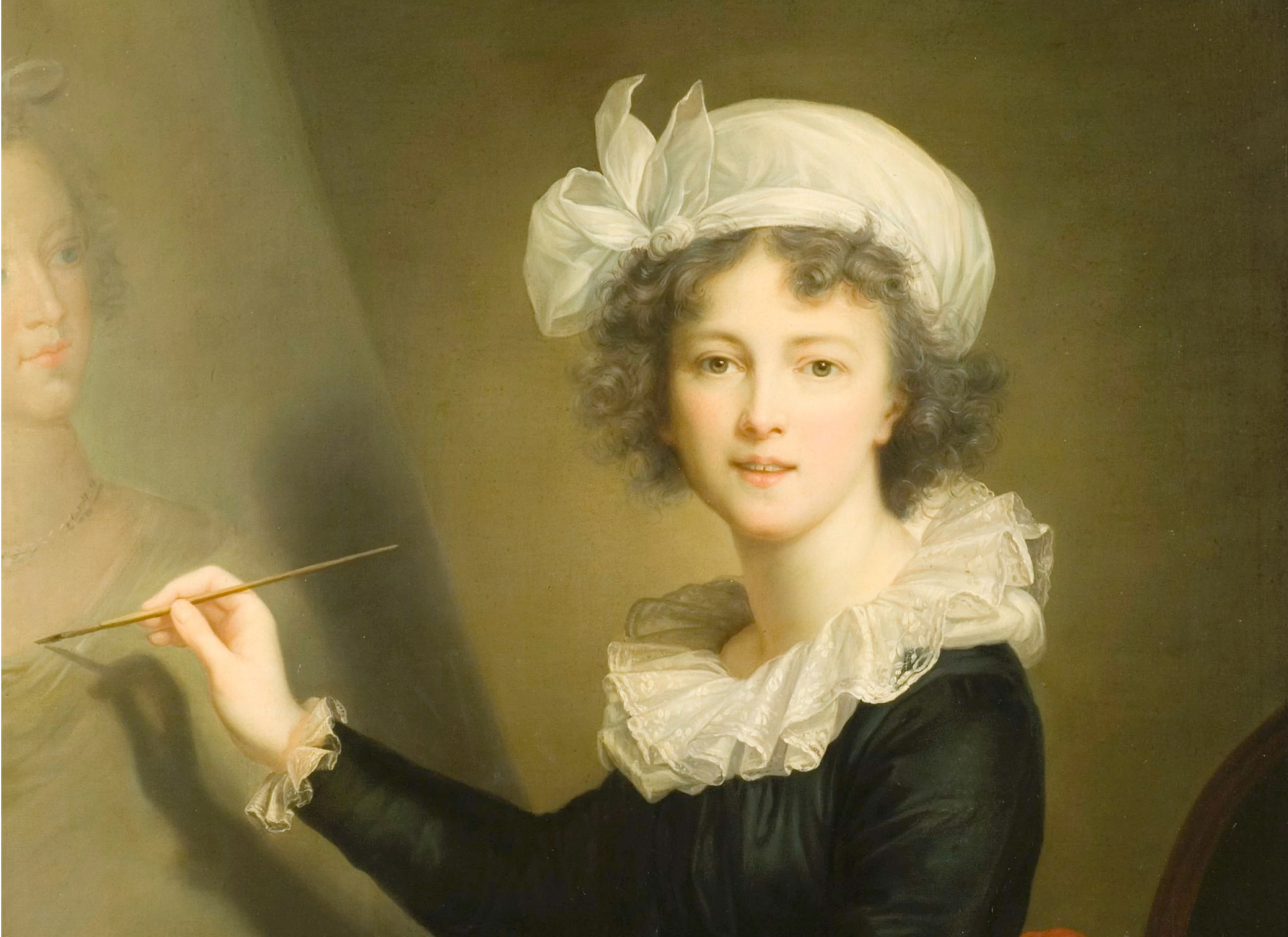
The loss came early and was devastating. Élisabeth Louise Vigée Le Brun was just twelve years of age when her father died in 1767, taking with him not just paternal affection but her primary artistic mentor. Louis Vigée had recognized his daughter’s talent and nurtured it carefully, teaching her the fundamentals of his own specialty—pastel portraiture. For most young women of the era aspiring to artistic careers, such a loss would have marked an ending. The father was typically the sole conduit to professional training, the gatekeeper who determined whether a daughter’s gifts would be cultivated or abandoned. But Elisabeth, as she would prove repeatedly throughout her life, had little use for conventional endings.
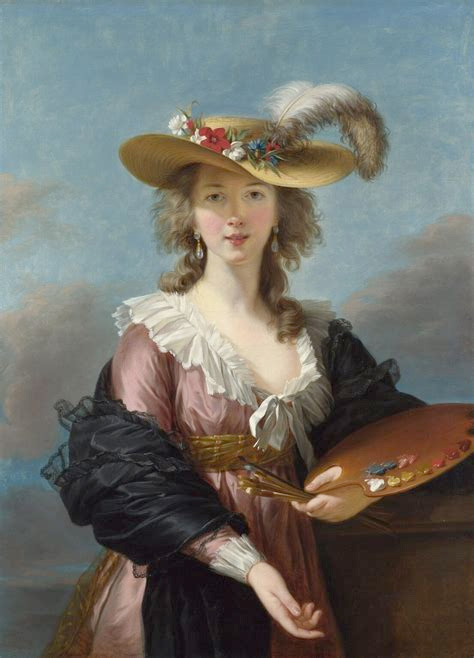
She continued her education through a network of established painters, some connected through family ties, others drawn by her evident talent. Gabriel François Doyen—the history painter who had been her father’s closest friend—urged her to return to painting after the initial grief subsided. Later, she sought guidance from Jean-Baptiste Greuze, Hubert Robert, and Joseph Vernet, absorbing their varied approaches. Vernet in particular shaped her developing aesthetic, encouraging her to study both the old masters and nature itself. It was advice she took to heart. In her memoirs, she recalls him as instrumental in teaching her to observe light and color in the natural world, lessons that would define the luminous quality of her mature work.
Among the old masters, it was Peter Paul Rubens whose bold, gestural technique captivated her most completely. The documented trip she took with her husband to Flanders and the Netherlands in 1781-82 proved transformative. There she encountered Rubens’s portrait of Susanna Lunden—known as Le Chapeau de Paille (The Straw Hat)—and the encounter lodged in her visual imagination. That same year, she painted her own self-portrait adopting elements of Rubens’s composition, a quiet homage to the Baroque master whose influence would continue to echo through her work.
Marie Antoinette was twenty-three herself when she first sat for Vigée Le Brun, already controversial and keenly aware of the precariousness of public opinion. She had married Louis XVI at fourteen and ascended to the throne at eighteen in 1774. Now, four years into her reign, she needed images that could counter the caricatures circulating in pamphlets and popular prints—the frivolous Austrian princess, the spendthrift queen, the foreigner who cared nothing for France. She needed portraits that would present her as elegant, dignified, unmistakably royal. The young queen also needed one to please her mother, who-as a reminder-was the Empress of Austria.
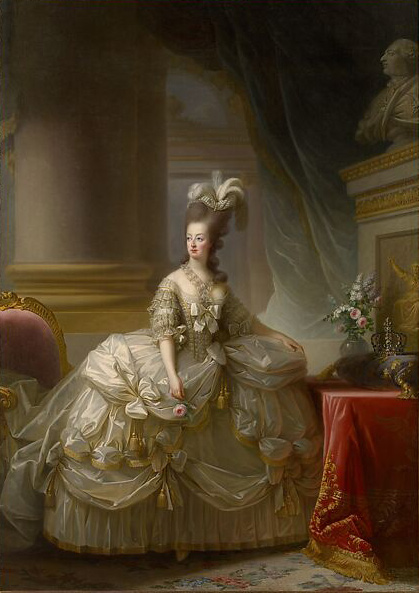
The first portrait fulfilled those requirements precisely. Vigée Le Brun painted the young queen in formal court regalia: an ivory-colored robe à la française with wide panniers, the rigid grand corps corset, all the visual markers of Rococo opulence that defined the French court. The composition included careful symbols of authority—a royal crown resting on a cushion decorated with fleur-de-lis, a portrait bust of the king positioned in the background. The painting was sent as a gift to Marie Antoinette’s mother, Empress Maria Theresa in Vienna, who responded with delight.
But beyond the formal commission, something unexpected developed. The relationship between artist and patron bypassed the usual hierarchies, settling instead into something closer to friendship. Marie Antoinette found the young painter gracious, intelligent, genuinely warm. Vigée Le Brun discovered that the queen bore little resemblance to her public reputation—she was kind, cultivated, far more complex than the cartoon villain of revolutionary pamphlets. Over the next decade, Vigée Le Brun would paint more than thirty portraits of Marie Antoinette, each one an attempt to capture not just physical likeness but something of the woman’s actual character.
The queen’s patronage brought more than commissions. It brought legitimacy in a profession that barely tolerated women. In 1783, with the king’s direct intervention, Vigée Le Brun was admitted to the Académie Royale de Peinture et de Sculpture. The achievement was nearly unprecedented. The Académie restricted female membership to four artists at any given time, and male academicians immediately raised objections—her husband’s profession as a commercial art dealer, they argued, compromised the dignity of the institution. Only the queen’s personal insistence overruled their resistance. For her reception piece, Vigée Le Brun submitted Peace Returning Abundance, an allegorical painting that announced her ambitions as a history painter. The Académie accepted it, though unusually, they didn’t require her to commit to a specific genre going forward. She would be known, ultimately, for something else entirely.
The portraits from this period revolutionized royal imagery. Vigée Le Brun painted Marie Antoinette with a softness and naturalism that had no precedent in French court painting. Where tradition demanded stiffness and formal grandeur, she offered gentle brushwork, luminous color, informal poses that emphasized the queen’s femininity and grace. The approach was radical precisely because it was so subtle..
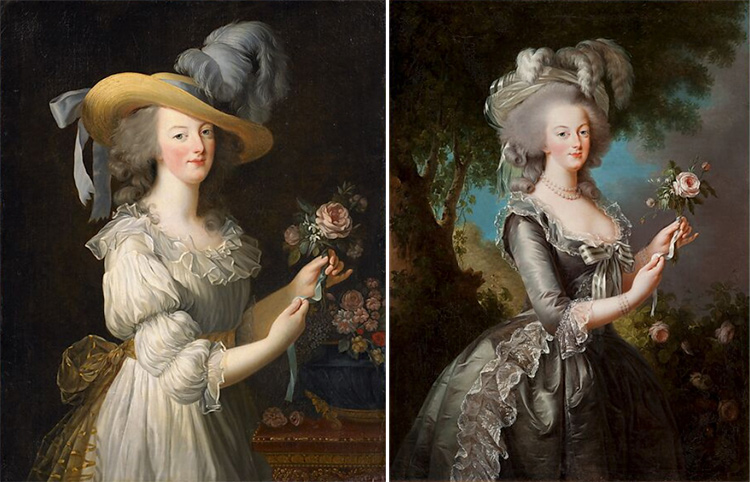
One portrait, however, proved too radical. Marie Antoinette in a Chemise Dress, exhibited at the Salon of 1783, ignited immediate scandal. The queen appeared in a simple white muslin dress, holding a rose, wearing a straw hat. To the viewing public, the offense was multilayered. First, the dress itself—it looked like undergarments, a shocking breach of royal dignity. Second, the material: English cotton rather than French silk, an insult to French textile manufacturers and, by extension, to French industry itself. Third, the rose: viewers interpreted it as a Habsburg rose, emphasizing Marie Antoinette’s Austrian heritage rather than her French queenship. The painting had to be removed from the Salon within days. Vigée Le Brun quickly produced a replacement—the same composition, but with the queen dressed in a handsome blue silk gown trimmed with ostrich feathers, the troublesome rose now transformed into an innocent bloom from the royal gardens at Versailles.
The controversy, in retrospect, was a warning of larger upheavals to come. As Charles Dickens famously wrote, “It was the best of times, it was the worst of time.” By 1789, the elegant world of Versailles was collapsing. Mobs gathered in Paris. The political situation deteriorated daily. Vigée Le Brun’s marriage to Jean-Baptiste-Pierre Le Brun had already unraveled, and now revolutionary authorities were questioning her connections to the court. A sympathetic guardsman advised her to leave Paris immediately. On October 5—the day of the Women’s March on Versailles—she fled with her young daughter Julie and the girl’s governess, traveling by public stagecoach in shabby clothes to avoid attracting attention. It was the beginning of a twelve-year exile that would take her through Italy, Austria, Russia, and England, painting royalty and aristocrats wherever she went.
Marie Antoinette and Louis XVI attempted their own escape in June 1791. They made it as far as Varennes, just forty miles from the border fortress that would have meant safety. There they were recognized, apprehended, brought back to Paris under guard. The failed flight sealed their fate. Charged with treason, Louis XVI was guillotined in January 1793. Marie Antoinette followed in October, maintaining her composure to the end. Vigée Le Brun learned of her friend’s execution while abroad. The loss would haunt her for the remainder of her life.
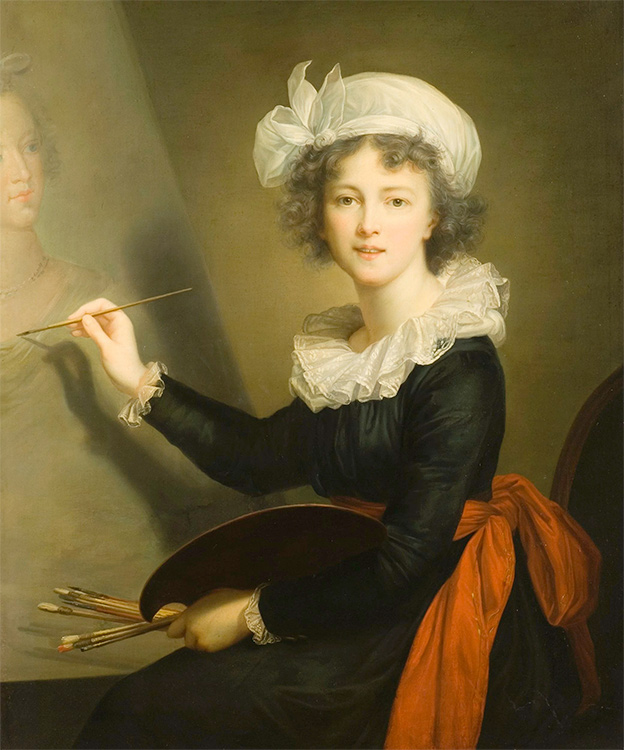
The portraits remain. They hang in major museums now, these images of a queen, and by extension an artist, who were more complicated than history often allows: beautiful certainly, but also intelligent, maternal, ultimately tragic. The range is remarkable—from the extravagant formality of the grand habit to the controversial simplicity of the chemise dress to the tender intimacy of the 1787 portrait showing Marie Antoinette surrounded by her children, a work that transcends its function as the ultimate PR campaign. Through Vigée Le Brun’s brush, we encounter the queen in all her contradictions.
The relationship between these two women—artist and patron, professional colleagues, something approaching friends—gave us more than magnificent paintings. It preserved a glimpse of a world about to vanish, and it reminds us that even within the rigid hierarchies of the ancien régime, genuine connection could take root. Vigée Le Brun’s vision of Marie Antoinette—nuanced, sympathetic, insistently human—continues to shape how we see one of history’s most controversial figures. Whether that vision brings us closer to truth or merely offers another kind of mythology remains, perhaps, an open question.
References
The Metropolitan Museum of Art. “Élisabeth Louise Vigée Le Brun (1755–1842).” Heilbrunn Timeline of Art History, May 2016, www.metmuseum.org/toah/hd/vgee/hd_vgee.htm.
—. “Elisabeth Louise Vigée Le Brun: Marie Antoinette in a Chemise Dress.” The Met Collection, www.metmuseum.org/art/collection/search/656930.
—. “Elisabeth Louise Vigée Le Brun: Marie Antoinette and Her Children.” The Met Collection, www.metmuseum.org/art/collection/search/656654.
—. “Elisabeth Louise Vigée Le Brun: Marie Antoinette with a Rose.” The Met Collection, www.metmuseum.org/art/collection/search/656931.
Vigée Le Brun, Élisabeth Louise. The Memoirs of Madame Vigée Lebrun. Translated by Lionel Strachey, Doubleday, Page & Company, 1903.