

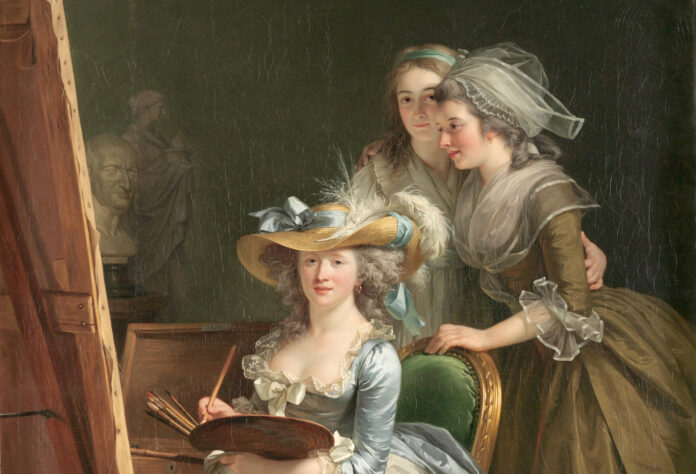

Adelaide Labille-Guiard was born in Paris in 1749 to a family of shopkeepers, but her artistic legacy is a reflection of her adept abilities as an artist and social networking. She began training with miniature painter François-Élie Vincent, whose studio was located on the same street as her father’s shop. She studied pastel under Maurice Quentin de La Tour, the French master influenced by Venetian pastellist Rosalba Carriera, whose 1720-21 visit to Paris sparked widespread fascination with the medium. Eventually she moved to oils, training under François-André Vincent, son of her first teacher and a childhood friend who would become her second husband decades later.
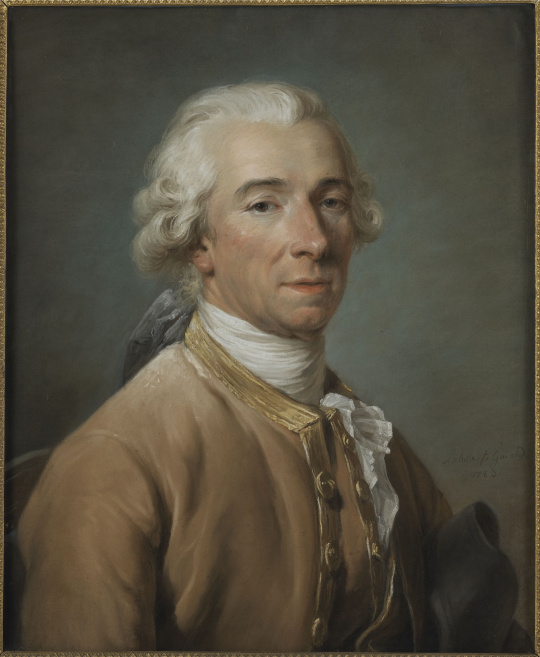
Her path to the Royal Academy was determined and strategic. During the late 1770s, after the Académie de Saint-Luc closed, Labille-Guiard systematically painted portraits of leading academicians—cultivating connections and demonstrating her mastery of oil painting, which the Royal Academy required for admission. Her relationship with François-André Vincent provided access to his influential teacher Joseph-Marie Vien. In May 1783, she was presented for admission by Alexandre Roslin, husband of the recently deceased academician Marie-Suzanne Giroust. At her first Salon that year, she exhibited seven pastel portraits of artists—including Vien, Jean-Jacques Bachelier, Jacques-Antoine Beaufort, Augustin Pajou, and her own self-portrait—a deliberate display of the professional network she had built.
On May 31, 1783, Labille-Guiard was admitted to the Académie Royale de Peinture et de Sculpture alongside Élisabeth Vigée Le Brun—the famed portraitist of Queen Marie Antoinette. The limitation was explicit: four women maximum, in contrast to approximately 150 male members. The two women became the twelfth and thirteenth female members in the Academy’s 135-year history. Immediately following their admission, the Academy voted to cap female membership at four—a number they had just reached. Both women faced immediate backlash. An anonymous pamphlet accused Labille-Guiard of trading sexual favors for artistic help, punning on Vincent’s name to claim she had “vingt cents”—two thousand—lovers. She successfully appealed to a patron to have the pamphlets removed, writing in a rare surviving letter: “One must expect to have one’s talent ripped apart, but who can plead on behalf of women’s morals?”
“Self-Portrait with Two Pupils” was a success. The painting is nearly life-size—depicting the artist seated at her easel in an exquisite blue satin gown, flanked by students Marie-Gabrielle Capet and Marie-Marguerite Carreaux de Rosemond. The scale announced ambitions beyond portraiture. This was advocacy for expanding the opportunities of women artists through paint.
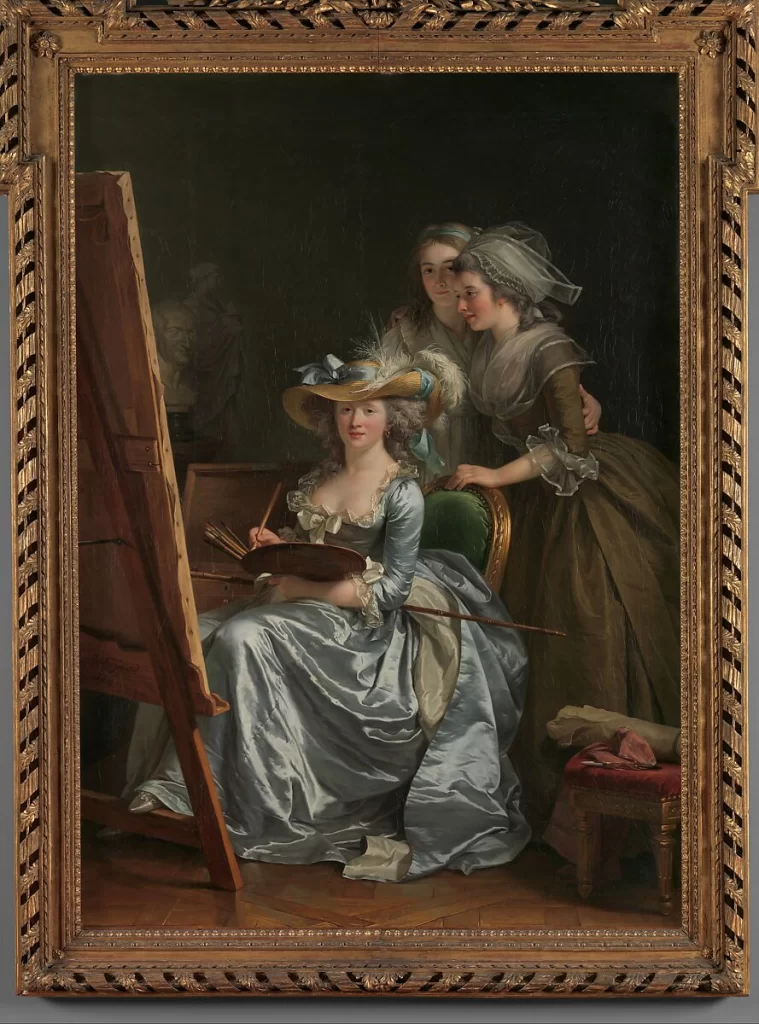
The painting itself operates on multiple levels. Labille-Guiard wears a luxurious blue satin dress with plunging neckline trimmed in lace, complete with complex scalloped lace false sleeves known as engageantes. Not exactly studio attire, but typical of eighteenth-century artists’ self-portraits—impractically elegant clothing signaling her professional status. The satin catches light beautifully, creating a soft reflection on the patterned wood floor. Then there’s the straw hat trimmed in satin, crowned with an ostrich feather, bearing striking resemblance to one worn by Vigée Le Brun in her own self-portrait a few years earlier. Homage or competitive jab? The question remains open to debate.
Behind the artist stand her two pupils, slightly elevated, suggesting a hopeful future built on training and mentorship. Capet, depicted modestly with a fichu filling in her neckline as appropriate for her unmarried status, would go on to have a respectable career. Carreaux de Rosemond, Swiss-born, died young in 1788, a casualty of the Revolution’s chaos. In the background: a bust of Labille-Guiard’s father and a classical statue of a Vestal Virgin, guardian of Rome’s eternal flame. The references align the work with Enlightenment ideals and rising Neoclassicism, incorporating history painting’s vocabulary into a “grand manner” style of portraiture.
The painting brought rewards. The comte d’Angiviller wrote to the King praising it as “worthy of the greatest masterpieces of the French school” and secured a lifetime pension for the artist. Madame Adélaïde reportedly sought to purchase it for 10,000 livres, then commissioned full-length portraits of herself, her sister Victoire, and her niece Élisabeth. Yet Labille-Guiard kept the painting, suggesting it carried personal resonance beyond professional advancement.
Unlike Vigée Le Brun, who fled France in 1789, Labille-Guiard welcomed the Revolution. She made substantial “patriotic donations” to support the National Assembly’s reformist work and continued painting vigorously through the upheaval. At the 1791 Salon, she exhibited fourteen pastel portraits of deputies to the National Assembly—including Maximilien Robespierre and other prominent revolutionaries. Her royal connections, however, made her politically vulnerable. On August 11, 1793, an order from the Directory of the Department of Paris forced her to surrender her royal commissions. According to a report delivered to the Committee on Public Instruction in May 1795, the Director “forced citoyenne Guiard to deliver to the procureur syndic the large and small portraits of the former prince and all the studies related to these works, to be devoured by flames.” Among the destroyed works was her unfinished large group portrait commissioned by the King’s brother, the Count of Provence—one of her most ambitious paintings.
The Terror forced Labille-Guiard into retreat. She fled to the village of Pontault-en-Brie with Vincent, Capet, and other students, keeping her head down while many of her former patrons faced the guillotine. The Académie Royale shut down in 1793. Though successor institutions like the Institut de France barred female members, the Salon exhibitions themselves had been opened to all artists since 1791, regardless of academy membership. When Labille-Guiard returned to Paris in 1795, she was granted artist’s lodging at the Louvre and a modest pension. She began painting again—brilliant portraits of revolutionary administrators, dramatists, and Vincent, whom she finally married in 1800 after divorce became legal. She continued exhibiting at the open Salons until 1800, but her work received little notice. She died in 1803, the promise embedded in that 1785 canvas—of expanded access and recognition for women artists—left unfulfilled for many generations.