


On the first day of class, as we turned our attention to the witty and whimsical world of Rococo, a student exclaimed, “That’s so tea!”—a phrase that sparked a ripple of laughter and agreement across the room (Well, the online Zoom chat room!). But what exactly is “so tea,” and, more importantly, what does “tea” even mean in this context? Before the student had finished bringing me at least somewhat up to speed on the latest slang, a particular painting – one not so Rococo – had already leapt to mind…
Mary Cassatt and the Art of Conversation in “The Tea”
Mary Cassatt ranks among the most celebrated American artists of the 19th century, a woman who boldly carved space for herself in the male-dominated Parisian art scene. Known for her intimate depictions of women and domestic life, Cassatt’s genius lay in elevating moments that might otherwise be dismissed as “ordinary,” giving the contemporary viewer unrestricted entry into the private sphere. One such moment can be found in her 1880 painting The Tea, aka Five O’clock Tea, where two women sit quietly in a parlor, with the polished silver tea set between them. The work is disarmingly simple at first glance, yet it reveals layers of artistic innovation, cultural influence, and a playful commentary on society.
Cassatt and Impressionism
Born in Pennsylvania, Cassatt came from a wealthy family who had mixed reactions to her desire to pursue a career in art. She first studied art at the Pennsylvania Academy of Art before moving to France in 1866 where she continued her studies in the private ateliers of Jean-Léon Gérôme and Thomas Couture and independently by copying at the Louvre-as women were not yet allowed to study at the prestigious École des Beaux-Arts. She gained admittance to her first Paris Salon just two years later in 1868. However, it was not in her formal studies, but a pair of chance encounters that would have a profound affect on her personal and artistic life.
Mary Cassatt first encountered Edgar Degas’ paintings in 1874 in an exhibition at the Durand-Ruel gallery, a moment she later described as a “turning point in my artistic life.” Degas, upon seeing Cassatt’s work at the 1874 Paris Salon, reportedly said, “There is someone who feels as I do.” Their formal meeting happened in 1877, when Degas visited her Montmartre studio and invited her to show in the upcoming exhibition, “Third Impressionist Exhibition” (Troisième exposition des Impressionnistes), and the only one to explicitly reference the term “Impressionist” in the official title.
Cassatt’s participation in their exhibitions placed her alongside names like Monet, Renoir, and Pissarro. Impressionism’s hallmarks — candid depictions of modern life, an interest in light, and vibrant brushwork — are visible in Cassatt’s art, though she often diverged from her peers in subject matter. Where Monet might capture a haystack or a foggy riverbank, Cassatt brought the same painterly sensitivity to salons, nurseries, and family parlors.
Degas & Japanese Prints
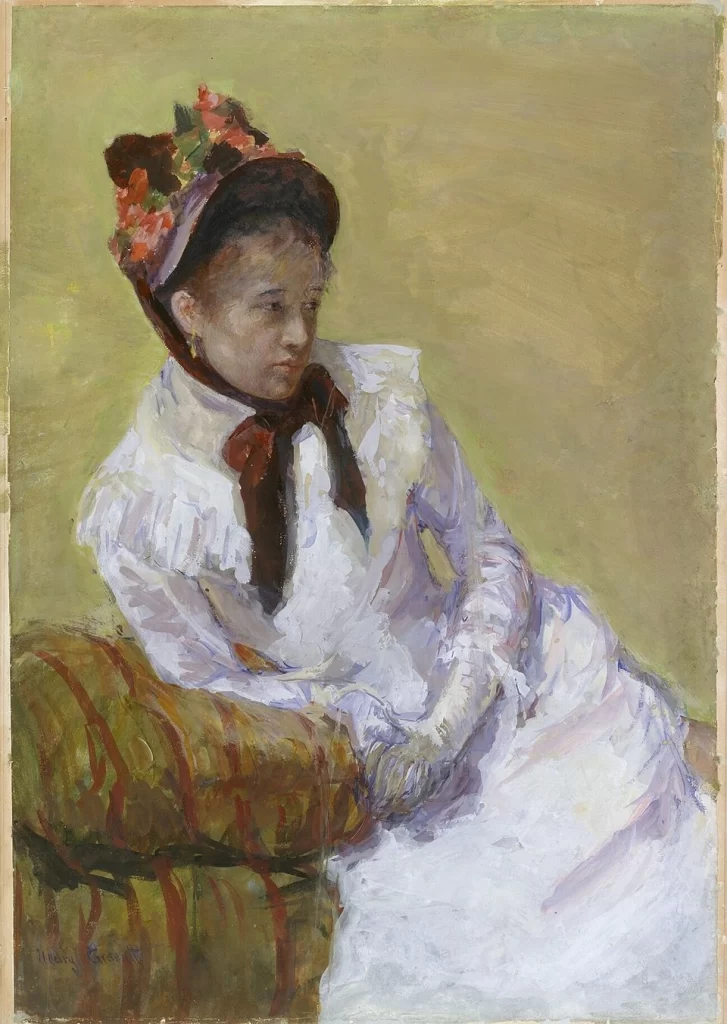
Her friendship with Edgar Degas was particularly influential. Degas introduced Cassatt to etching, encouraged her to experiment with unusual perspectives, and inspired her to push the boundaries of composition. But if Degas’s works often carried a sharp, voyeuristic edge, Cassatt’s retained gentleness, empathy, and an insider’s gaze on women’s experiences.
Another crucial influence on Cassatt’s artistry was Japonisme, the 19th-century fascination with Japanese prints. When Japanese woodblock prints flooded Europe, Cassatt was captivated by their flat planes of color, decorative patterns, and unconventional cropping of scenes. These characteristics show up throughout her work, including The Tea. Notice how the background space flattens into fabrics and wallpaper, almost like paper patterns layered together. Gone is the illusionistic depth of traditional Western art; instead, we see compressed space, elegant shapes, and visual rhythms informed by the Japanese aesthetic.
Looking at “The Tea”
In The Tea, Mary Cassatt presents what seems like an everyday social ritual in a painting that is trademark Cassatt in subject and style. Two women sit in a richly decorated salon enveloped by vibrant striped wallpaper interrupted with elaborate fireplace mantle topped with blue-and-white porcelain vase, a simple touch reflecting the current trend of Japonisme in decor. Layers, patterns, and textures amplify the sense of place. In contrast to the visual complexity, the figures within the composition avoids any grand gestures. Instead, Cassatt captures subtle dynamics: the lean of one figure deep in thought, the slight barrier created by the cup, the delicate tension between presence and concealment. The tight framing, much like those Japanese prints she admired, heightens awareness of detail.
Even more, the attire worn by these women demonstrates just how central fashion was in signaling status and identity in these settings. In her attention to dress, Cassatt was not merely illustrating clothing but revealing how costume shapes performance in social exchange.The hostess is recognized by her lack of the social accoutrements that were associated with being seen in the public sphere. Her visitor, in contrast, is smartly accessorized with long gloves, scarf and hat that suggest proper decorum, and perhaps some brisk weather, she has braved to come meet her companion.
Cassatt has opened the door to a shared moment, entirely private yet palpably significant. The scene has paused: the hostess sinks into her plush floral couch while her guest raises a teacup to her lips, glancing stage left as if waiting for the coast to clear. What is the meaning of this exchange: Are they sharing secrets? locked in polite silence? The unanswered questions give the scene its mystery and pulls us in, waiting for that moment of revelation. What might simply read as an afternoon visit between friends unfolds into a quiet drama. Cassatt’s way of saying, long before the latest trends on social media — that’s so tea.
The Legacy of Cassatt’s Moments
What makes The Tea both remarkable and relatable is Cassatt’s ability to heighten the drama of an everyday moment. Through Impressionist brushwork, the flattening effects of Japanese prints, and a discerning eye for costume and gesture, she evokes the timelines in small exchanges. While her male contemporaries painted city boulevards, outdoor gatherings or ballet rehearsals, Cassatt turned our attention to the interior, reminding us that intimacy, conversation, and female camaraderie can be just as worthy a subject for art.
More than a portrait of two women, The Tea is a study in perception: who speaks, who listens, what is revealed, and what remains concealed. She creates a space for the viewer to fill in the moment, to play our own part in filling out the narrative. In it, Cassatt crosses boundaries of culture, style, and time — bringing 19th-century Paris into dialogue with our present-day.