


The following passages are translated from “Winckelmann’s History of the Art of Antiquity, 1770. (Translated by E.S. Morgan, published January 1, 1869, The Journal of Speculative Philosophy)
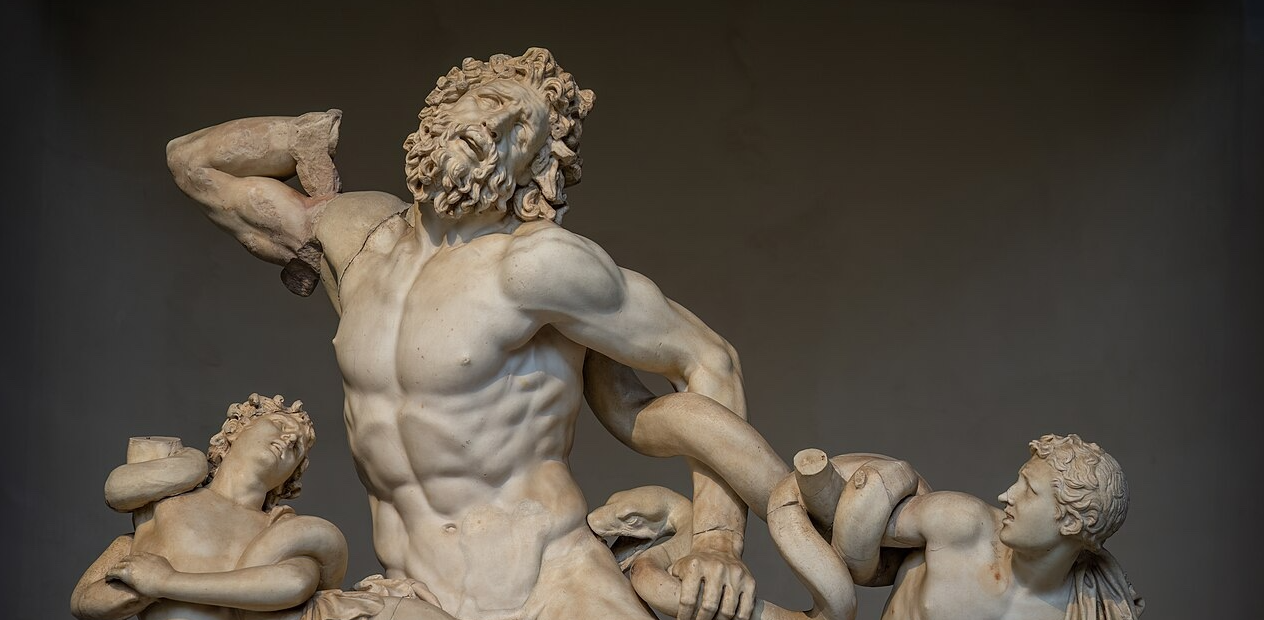
Amidst the destruction of innumerable works of art belonging to this time of Art’s greatest perfection, the statue of Laocoön, of those which escaped entire, is the most valuable monument, if the artists who made it lived in the time of Alexander the Great; this, however, we have no means of proving, although the perfection of the statue makes it probable : for Pliny mentions this as a work which must be ranked above all other efforts in painting as well as in sculpture. The authors were Agesander, Polydorus, and Athenodorus of Rhodes, of whom the third was a son of the first, as, in all probability, was also the second; for that Athenodorus of Rhodes was a son of Agesander, the following inscription on the base of a statue in the villa Albani bears witness: Athenodorus the Rhodian, son of Agesander, made this”: and the statue of Laocoön renders it probable that Polydorus was also the son of Agesander, because upon any other supposition we cannot explain how three artists could (1 will not say, work on one and the same statue, but) distribute their labors, because Laocoön the father is a much more considerable and important figure than his two sons. Consequently, Age sander must have wrought out the figure of the father, and his two sons, the figures of the sons of Laocoön.
The well-known base which was discovered in the ruins of the old Antium of the Lord Cardinal Alex. Albani, is of black marble; but a statue of white marble was joined to it. A piece of this statue, a part of a mantle hanging in folds which was a chlamys, was found near the base; but no trace of the figure itself could be found.
The statue of Laocoön stood formerly in the palace of the Emperor Titus, and was discovered there (not as Nardini and others assert, in the so-called seven saloons or reservoir of the baths) in the arch of a hall which seems to have been a part of the baths of this Emperor; but it indicates, by just this discovery, the precise situation of the imperial palace as it was connected with the baths. Here stood the Laocoön in a large niche at the end of the frescoed saloon already alluded to, from the paintings of which the falsely so-called Coriolanus-under-the-cornice has been taken.
Pliny mentions that the three figures of the Laocoön were hewn out of a single block of stone—which seemed so to him because no seams were discoverable, not that it was really so; for a couple of thousand years have revealed a scarcely perceptible seam which shows that the elder of the two sons was separately sculptured, and afterwards joined to the other figures. Michael Angelo conceived the idea of completing the right arm of Laocoön, which was wanting, and which had been supplied by one of burnt clay; accordingly he made one roughly out of marble, but never finished it; since that time this piece has lain at the base of the statue. This arm, encircled by serpents, would have bent over the head of the statue, and (inasmuch as the rest of the figure was free) it may have been the design of this artist to intensify the conception of suffering in Laocoön by approaching this arm to the head as in two united ideas, and by the repeated coils of the serpent to centre here the place of the pain, which the old artists had reconciled with the beauty of the figure, as both the suffering and beauty find expression here. But it seems as if this arm bent above the head would have distracted the principal attention, which the head demands, for the glance would have been directed at the same moment to the many coils of the serpent. Therefore, Bernini supplied an arm of burnt clay extended so as to leave the head free, and to bring no other part in close proximity above the head.
The two steps at the lower part of the base upon which the principal figure rests probably indicate the steps of the altar where the occurrence here represented took place.
Inasmuch as this statue was prized as the highest work of art by so many thousands of the most celebrated artists brought from all parts of Greece to Rome, it deserved so much the more attention and admiration from a degenerate posterity which knew how- to produce nothing which should even remotely compare with this work. The wise man finds here matter for research, the artist finds endless subjects for study, and both will be convinced that in this picture more lies concealed than meets the eye, and that the mind of the master was even greater than his work.
Laocoön is a nature in extremity of suffering, represented in the form of a man who seeks to gather up the conscious strength of his spirit to subdue it; and while suffering swells the muscles and contracts the nerves, the spirit armed with strength displays itself in the furrowed fore head,—the breast heaves with interrupted respiration, and with the suppression of the outbreak of feeling in his effort to contain and shut up the pain within himself. The anxious inward sigh, and the breast drawn in, exhaust the abdomen and hollow the sides, which allows us to judge of the action of the intestines. But his own suffering seems to distress him less than the suffering of his children, who turn their faces to him and cry for help; for the father’s heart reveals itself in the sorrowful eyes, and compassion scorns to swim in them in a dim mist. The face is mournful, but there is no outcry; the eyes are upturned toward the highest help. The mouth is full of sadness, and the sunken nether lip is heavy with it; but in the upper lip, which is drawn back, this expression is mingled with that of pain, which, with a movement of anger as if an unmerited, unworthy sorrow, extends to the nose, swells it, and manifests itself in the distended and widened nostrils. Below the forehead, the struggle between pain and resistance is portrayed with the greatest wisdom; for while pain elevates the eyebrows, the effort to resist it presses the flesh just over the brows down upon the upper lid, so that the protruding brow almost covers it. Nature which the artist could not improve, he has sought to develop and represent in its greatest strength and power; for where the greatest suffering is portrayed, there the highest beauty is possible. The left side, where the serpent’s maddening bite has injected the poison, is the one which, from its proximity to the heart, seems to be most capable of suffering, and this part of the body may well be called a marvel of artistic skill. He raises his legs involuntarily as if to run from the evil: no part is at rest; even the strokes of the chisel seem to aid the significance of this rigid surface.