


William Hogarth is best known today for his satirical prints—the cautionary tale of A Harlot’s Progress (1731-32), the doomed aristocratic marriage of Marriage A-la-Mode (1745)—moralizing series that skewered Georgian society with devastating wit and many others. But Hogarth the painter and caricaturist, however brilliant, isn’t the whole story. It was Hogarth as founder, theorist, organizer, the cultural agitator who arguably did more to shape British art than any of his engravings ever could.
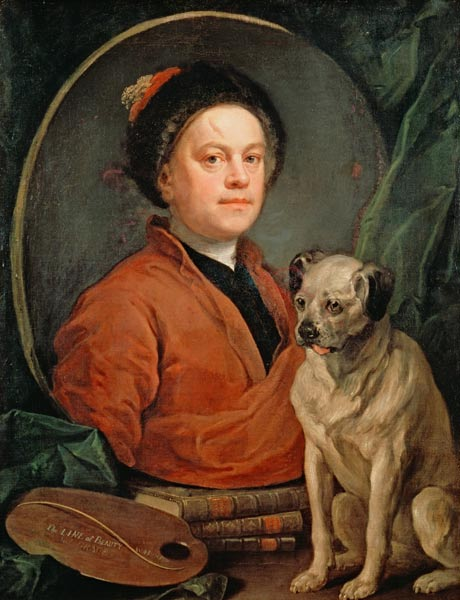
William Hogarth was born in 1697 to a struggling London family. His father, Richard, was a classically educated schoolmaster who tried to improve his fortunes by opening a Latin‑only coffee house—a fashionable gimmick in an era when coffee houses often cultivated linguistic or intellectual identities. The experiment failed, and he was imprisoned for debt in the notorious Fleet Street Prison for several years, a harsh but common fate in 18th‑century Britain, where many inmates were jailed not for crimes but for unpaid bills. The Hogarth’s, including young William, lived nearby in the cheap, crowded lodging houses that surrounded it, a grim district known as the “Rules,” where debtors’ families clustered in equally desperate conditions. Young Hogarth visited his father often, and the experience left a lasting mark.
After his father’s release, Hogarth was apprenticed around 1713 to the silver engraver Ellis Gamble, where he began his formal artistic training. The work was technical and disciplined—engraving shop bills, trade cards, and decorative silver—but it gave him a mastery of line and detail that would later define his prints. By 1720 he had opened his own print shop, taking on commercial commissions while studying drawing and painting at informal academies around London. His ambition was clear: engraving paid the bills, but painting was the goal. It was an ambition he achieved, but would not define his greatest success.
In 1732, Hogarth found his first major success in A Harlot’s Progress, a six‑part moral narrative that made him famous. The series follows the downfall of Moll Hackabout, loosely inspired by the real Kate Hackabout, from her hopeful arrival in London, entanglement with prostitution and subsequent downfall leading to her death in a debtor’s hospital. Hogarth first painted the scenes (the originals were later lost in a fire) and then invited the public to view them, offering advance subscriptions for engraved versions of the painting. Each of the six panels was densely populated with mini-dramas supplementing the main arch. The viewer quickly grasps that Hogarth’s critique was not solely pointed at the naivety of the main character but the entire cultural framework that led to her downfall. In the impoverished city street we find a satirically assembled cast surrounding young Moll: the overworked laundress, the oblivious clergyman, the deceitful madam, and the overworked laundress, the oblivious clergyman, the deceitful madam, and the notorious criminal lecherous aristocrat—Colonel Francis Charteris—and that’s just the first plate!
The strategy was an entrepreneurial transformation. Instead of relying on a single aristocratic patron, he sold more than a thousand subscriptions at one guinea each—an amount within reach for many middling Londoners. As a result, he earned far more than the original series of paintings would have gained. The prints became a sensation, and Hogarth emerged as one of the first British artists to cultivate a truly mass audience.
Hogarth’s success with narrative series and his innovative subscription model soon allowed him to settle in the fashionable Leicester Fields district (modern‑day Leicester Square), securing both financial stability and a lasting place in English art history. But it was his actions beyond commercial success that helped transform London into an artistic center capable of rivaling the continental academies. In 1735, following the triumph of A Harlot’s Progress, Hogarth revived the St. Martin’s Lane Academy in Peter Court—a continuation of the earlier Chéron–Vanderbank life‑drawing school that had operated on the same street a decade earlier. Although he had not studied at that earlier academy, he admired its independent, artist‑run model and sought to preserve its spirit. The original school, formally advertised as “The Academy for the Improvement of Painters and Sculptors by drawing from the Naked,” had been one of the first places in London to offer consistent access to life drawing. It collapsed in 1724 after its treasurer embezzled the subscription funds, but Hogarth’s revival restored its core purpose: regular life drawing in an informal, subscription‑based setting rather than formal classes with instructors.
St. Martin’s Lane was radical precisely because of what it lacked: no royal sanction, no aristocratic patronage, no rigid hierarchies. In this modest space, trained artists gathered to sketch from live models, to debate, and to cultivate what Hogarth believed was a distinctly English approach to art—one rooted in direct observation rather than the classical prescriptions of continental academies. The St. Martin’s Lane Academy was never a formal school; it functioned instead as a collaborative hub, a shared life‑drawing room used by artists who had already completed their foundational training elsewhere, whether through apprenticeships, private instruction, or study abroad.
The surrounding neighborhood soon became the center of London’s artistic life, with studios, workshops, and coffeehouses clustering around the academy. Among those active in this circle were Francis Hayman; Richard Wilson, who would help define the English landscape tradition; a young Thomas Gainsborough; the sculptor Louis‑François Roubiliac; and George Michael Moser, later the first Keeper of the Royal Academy. His daughter, Mary Moser, would become one of only two female founding members of that institution and a celebrated still‑life painter. St. Martin’s Lane served as both meeting ground and incubator—the place where the cooperative spirit that would reshape England’s art world first took hold.
Hogarth’s Line of Beauty
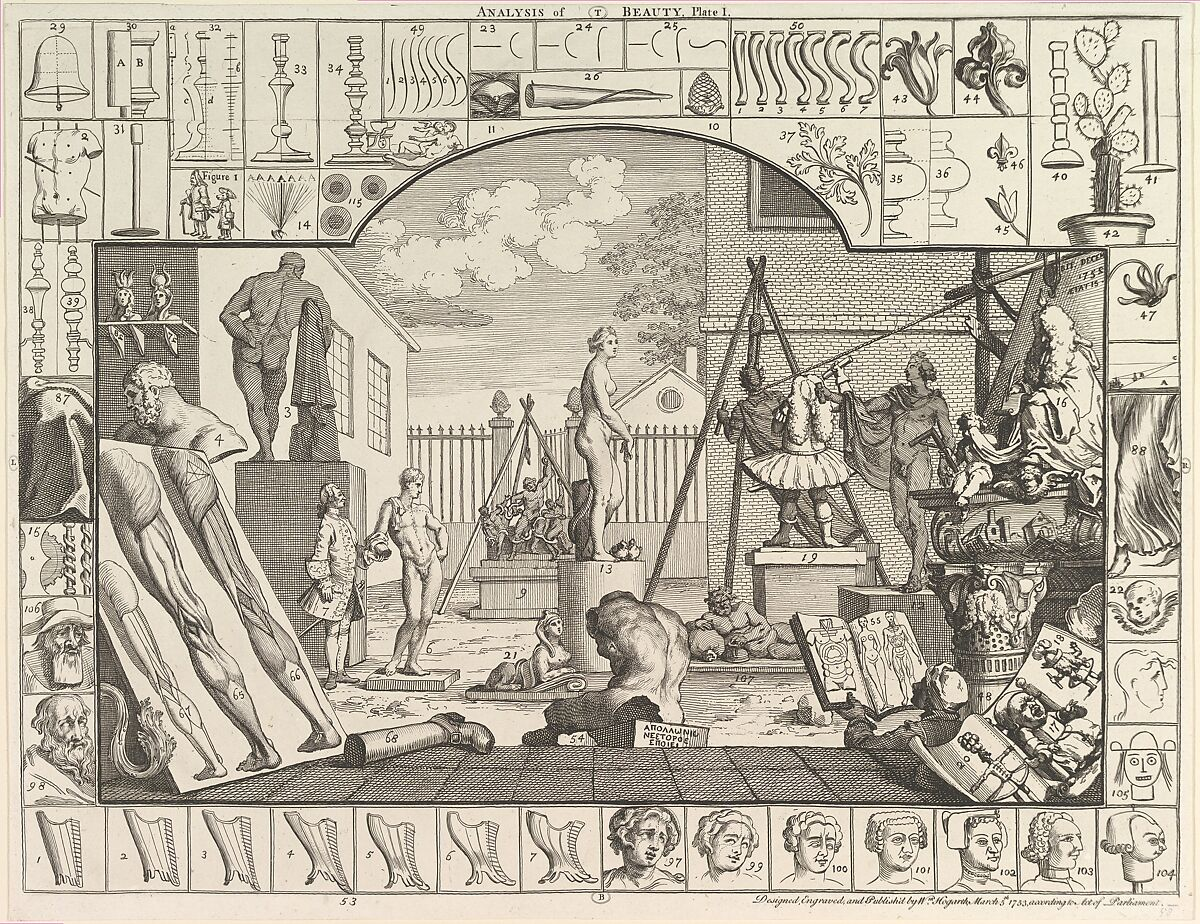
By 1753, Hogarth had articulated his aesthetic philosophy in The Analysis of Beauty, introducing what he called the “Line of Beauty”—the serpentine, S‑shaped curve he believed embodied grace in both art and nature. The treatise was his rebuttal to rigid academic formulas, a manifesto arguing that aesthetic pleasure did not reside in the fixed proportions of classical sculpture but in the organic, the irregular, the lively. Beauty, he insisted, was not the exclusive property of academies or aristocrats but something observable by anyone willing to look closely at the world. Perhaps this conviction reflects the lessons of his impoverished youth, when he learned to find vitality even in desolate surroundings.
But even as Hogarth published his vision, tensions were emerging within his own artistic community. That same year, Francis Milner Newton—then serving as secretary to the St. Martin’s Lane Academy—circulated a proposal for something Hogarth had long resisted: a formal public academy with elected professors and hierarchical authority. Hayman and several other members supported the plan. Hogarth did not. He had built the St. Martin’s Lane Academy on deliberately democratic principles—equal subscriptions, shared governance, rotating responsibility—precisely to avoid the rigid structures of continental institutions. Confronted with a movement toward the very model he opposed, Hogarth began to withdraw from the academy he had helped revive.
Hogarth’s democratic vision soon extended beyond his personal theory. By 1760, the collaborative energy that had defined St. Martin’s Lane evolved into something unprecedented: the first public exhibition of contemporary art in England. Artists charged a shilling for admission, and the public came. A middle‑class merchant could stand beside an aristocrat, surveying portraits and landscapes, perhaps even considering a purchase. Newspapers began publishing reviews, marking the birth of modern art criticism in England. The exhibition’s organizers—led by Hayman, a central figure at St. Martin’s Lane, and Reynolds, who worked closely with artists from its wider community—formalized their efforts by founding the Society of Artists the following year.
Built on a foundation of conflicting visions, the Society of Artists was beset by factionalism from the start. Some members, shaped by the egalitarian spirit of St. Martin’s Lane, argued for rotating leadership and shared governance. Others, led by Joshua Reynolds, pushed for hierarchy and permanence, envisioning an institution modeled on the French Royal Academy. In 1768, with the backing of George III, Reynolds and his allies—including Benjamin West and Angelica Kauffman—broke away to found the Royal Academy of Arts.
The new institution brought prestige and formal structure, but it also represented a fundamental philosophical break from Hogarth’s vision. Reynolds championed the “Grand Manner”—an elevated style rooted in classical ideals and what Edmund Burke called the “Sublime,” emphasizing grandeur, nobility, and timeless beauty drawn from ancient Greece and Rome. This stood in direct opposition to Hogarth’s Analysis of Beauty, which had rejected such rigid academic formulas in favor of the serpentine “Line of Beauty” he found in nature and everyday observation. Where Hogarth insisted that aesthetic pleasure was accessible to anyone willing to look closely at the world around them, Reynolds’s Academy elevated learned connoisseurship and adherence to classical tradition. The Society of Artists, politically weakened by the schism, quickly faded in influence.
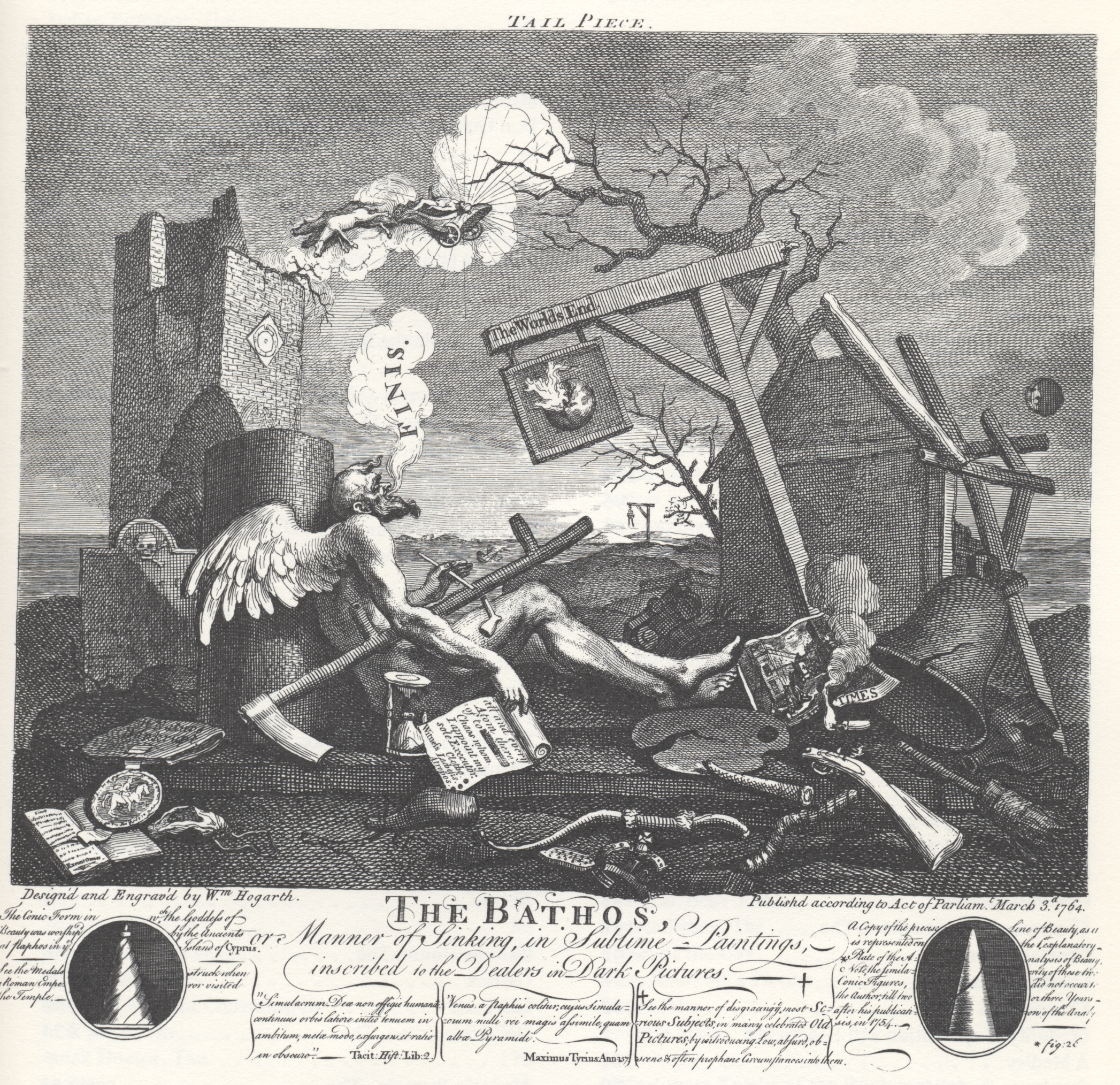
This transformation had been years in the making. Hogarth didn’t live to see the Royal Academy’s founding—he died in 1764—but he had watched the trends building, had seen his own colleagues abandon the democratic principles of St. Martin’s Lane in pursuit of formal recognition and royal patronage. His final print, Bathos, can be read as both prophecy and protest. Depicting Father Time expiring amidst ruins and symbols of artistic decay, it was a scathing satire on the aesthetic trends he saw overtaking the art world, particularly the growing fashion for the Sublime—that aesthetic of overwhelming grandeur and terror championed by Edmund Burke in his 1757 treatise A Philosophical Enquiry into the Origin of Our Ideas of the Sublime and Beautiful. Bathos presents viewers with a cacophony of Sublime clichés, an ironic catalog meant to exhaust the fashion and restore good sense. Even at the end, Hogarth refused to bend to academic fashion.
Out of these quarrels and competing visions emerged the basic architecture of the English art world: public exhibitions, professional training, critical discourse, and institutional authority. Reynolds’s Royal Academy would go on to champion the Grand Manner—nobility, idealization, and classical precedent—and that aesthetic would shape British art well into the nineteenth century. But the world that formed around it still carried traces of Hogarth’s influence. His vision of art as lively, observational, and accessible to all never vanished; it persisted in the satirical traditions that flourished outside academy walls and in the stubborn belief that beauty could be found in ordinary life, not only in classical models.
Where Hogarth had once trained his satire on the social hypocrisies of his age—from the pretensions of the aristocracy to the brutal fate of a young girl pushed into prostitution—he now turned that same critical eye on his own profession. His final print, Bathos, makes his disillusion unmistakable. Father Time collapses amid broken columns, shattered palettes, and symbols of artistic decay: a bitter send‑off to the rising fashion for the Sublime and the grandiose spectacle he saw overtaking British art. It is Hogarth’s last, sharp reminder that the future of art need not belong to academies or aristocrats alone. The irreverent, democratic, defiantly English spirit he championed—rooted in observation, vitality, and the everyday—remains one of his most enduring legacies.
Sources:
- Government Art Collection, https://artcollection.dcms.gov.uk/