


The history of art is full of rivalries, some real others… well, perhaps embellished a bit for dramatic flair. One such example is the somewhat exaggerated contentious relationship between the royalist Elisabeth Marie Vigée Le Brun and the revolutionary Adelaide Labille-Guiard. Truth be told, they both challenged the status quo as female painters breaking their way both into the French Royal Academy, as well as positions within the royal court. Vigée Le Brun became famous for her position as the painter of Queen Marie Antoinette and perhaps for that reason, remains better known today. Labille-Guiard, appointed the painter of the king’s aunts, used her position in the academy as a means to champion support for future generations of female artists, securing her own place in our hearts today.
Unlike most female artists of her time, Adelaide Labille-Guiard was not born into an artistic household to be trained by her father or close family member. Rather, she was born on April 11, 1749 to a family of shopkeepers. But location, location, location as they say, and as fate would have it, located on the same Parisian street as her father’s shop, was the studio of François-Élie Vincent, a miniature painter who became her first mentor. She later studied pastel under Maurice Quentin de La Tour, a French master influenced by the famous Venetian pastelist Rosalba Carriera. Internationally famous, the Italian portraitist had spent a year in Regency Paris where she painted pastel portraits of a wide range of cultural figures, ranging from Rococo pioneer Jean-Antoine Watteau to a young King Louis XV, and the influence of Rosalba’s softly layered pastels continued to manifest in Paris long after her return to Italy.
To establish herself many decades later, Adelaide joined the Académie de Saint-Luc, an artistic guild in Paris that, unlike the Royal Academy, opened its doors to female membership. Her career in pastel portraiture began as expected and may have continued on this predictable route until a most unexpected event occurred that put a new roadblock on the young artist’s path. In 1775, the French Royal Academy deemed that the Académie de Saint-Luc was a rival to its prestigious authority and petitioned the king to close down their pesky rival, leading to the closure of the guild in February of the following year.
The closure of Saint-Luc was devastating to a great many of the 100-plus female artist members, and only a limited number of females were to be admitted to the Royal Academy. A grand concession, indeed! For Adelaide in particular, it brought the demand to study oil painting, a requirement for admittance to the lofty royal halls. This led back to that little street, this time studying with François-André Vincent, the son of her first teacher and childhood friend destined to become her second husband decades later. This relationship was not only pivotal for her training but, equally important, brought her into contact with other influential academicians of the Royal Academy, including Joseph-Marie Vien who is best known today as a leading proponent of an austere Neoclassical style and the mentor of Jacques-Louis David. Small world.
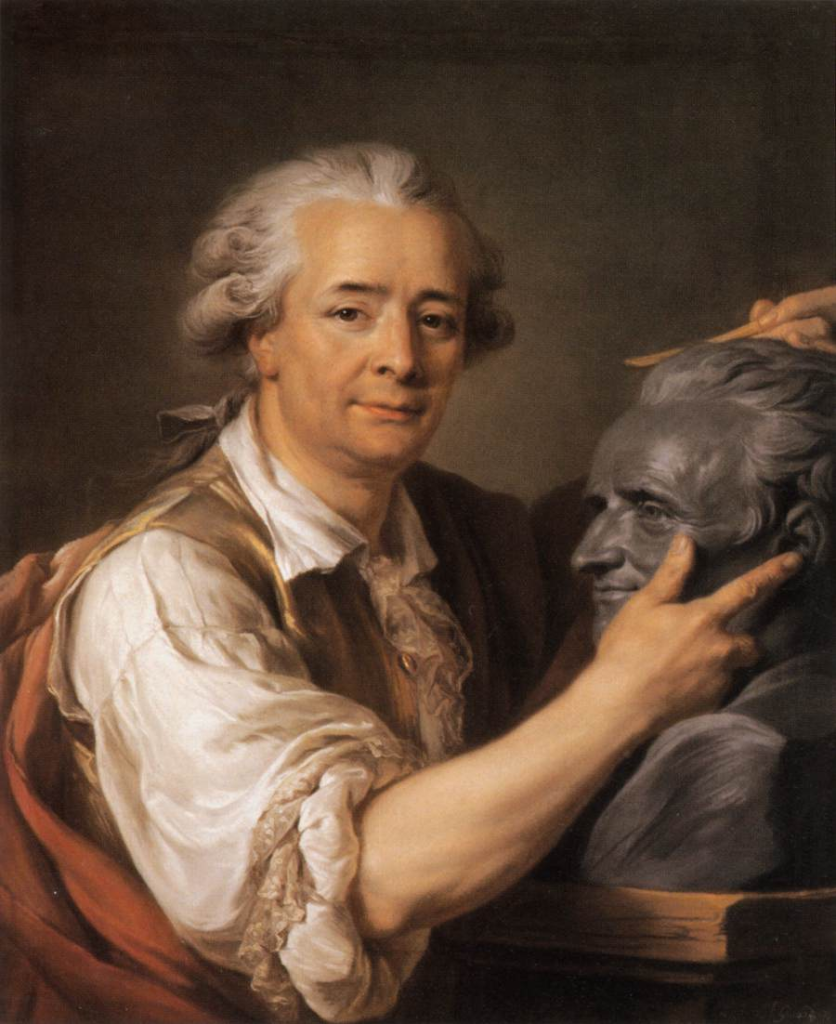
Labille-Guiard systematically painted portraits of leading academicians—cultivating connections and demonstrating her mastery of oil painting, which the Royal Academy required for admission. In May 1783, she was presented for admission by Alexandre Roslin, husband of the recently deceased academician Marie-Suzanne Giroust. At her first Salon that year, she exhibited seven pastel portraits of artists—including Vien, Jean-Jacques Bachelier, Jacques-Antoine Beaufort, Augustin Pajou, and her own self-portrait—a deliberate display of the professional network she had built.
The strategy worked. On May 31, 1783, Labille-Guiard was admitted to the Académie Royale de Peinture et de Sculpture alongside Élisabeth Vigée Le Brun—the famed portraitist of Queen Marie Antoinette. The limitation: four women maximum, versus roughly 150 men. The two women became the twelfth and thirteenth female members in the Academy’s 135-year history. Immediately following their admission, the Academy voted to cap female membership at four—a number they had just reached. Coincidence? Hmmm….
Pushback against even allowing four women manifested in a predictable manner: if you can’t attack their talent, attack their character. An anonymous pamphlet—Suite de Malborough au Salon 1783—accused Labille-Guiard of trading sexual favors for artistic help, with a truly terrible pun on Vincent’s name claiming she had “vingt cents”—two thousand—lovers. She successfully appealed to a patron to have the pamphlets removed, writing in a rare surviving letter: “One must expect to have one’s talent ripped apart, but who can plead on behalf of women’s morals?”
Two years later, the artist’s Self-Portrait with Two Pupils (1785) was more than a success—it was a manifesto. Nearly life-size at over six feet tall, the painting commands attention through scale alone, but it’s Labille-Guiard’s direct, unflinching gaze that holds the viewer. She meets our eyes with absolute confidence, brush at the ready on her palette, caught mid-gesture as if we’ve interrupted her work. The technical bravura is unmistakable. That blue satin gown—utterly impractical for studio work, complete with plunging neckline and elaborate engageantes (those complex scalloped lace false sleeves)—catches light with liquid precision, creating soft reflections on the patterned wood floor below. The straw hat, trimmed in satin and crowned with an ostrich feather, bears striking resemblance to one Vigée Le Brun wore in her own self-portrait a few years earlier. Homage, shade, or simply fashion? Art historians are split. What’s certain: this is a woman who understood that professional identity required performance, that appearing as an artist meant dressing like one’s patrons while demonstrating mastery of the very fabrics they wore.
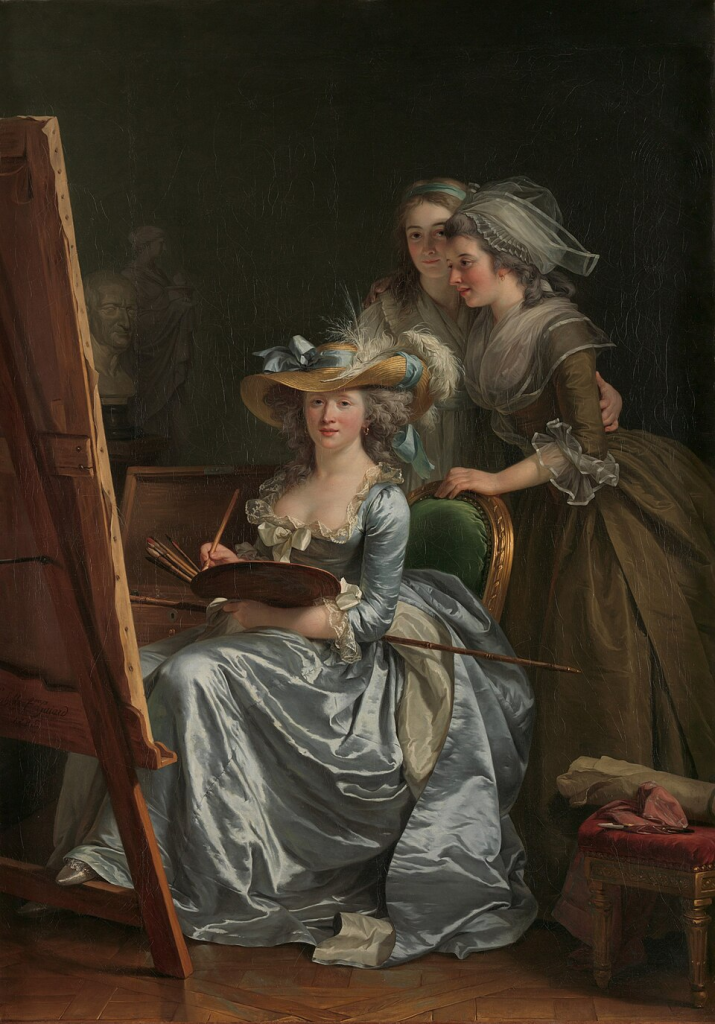
Behind the artist stand her two pupils, slightly elevated on a platform, a not-so-subtle symbol of her advocacy. Marie-Gabrielle Capet, depicted modestly with a fichu filling in her neckline as appropriate for her unmarried status, leans forward in rapt attention, her gaze fixed on the canvas in progress. She would go on to have a respectable career, remaining with Labille-Guiard for over twenty years and eventually painting her own tribute to her teacher. Marie-Marguerite Carreaux de Rosemond, Swiss-born, stands beside her—she would die young in 1788, a casualty of the Revolution’s chaos. In the shadowy background, carefully placed: a bust of Labille-Guiard’s father and a classical statue of a Vestal Virgin, guardian of Rome’s eternal flame. The references align the work with Enlightenment ideals and rising Neoclassicism, incorporating history painting’s vocabulary into what should have been a simple portrait. The message was explicit: women artists deserved a future, and she intended to secure it.
The painting was a calculated gambit, and it paid off. The comte d’Angiviller wrote to the King praising it as “worthy of the greatest masterpieces of the French school” and secured a lifetime pension for the artist—or at least that was the intention. Madame Adélaïde—the king’s aunt—reportedly sought to purchase it for 10,000 livres. When Labille-Guiard refused to sell, Adélaïde commissioned full-length portraits of herself, her sister Victoire, and the king’s sister Élisabeth instead. By 1787, Labille-Guiard had earned the official title Peintre des Mesdames—painter to the royal aunts—cementing her position at court. It was exactly the kind of royal patronage every ambitious artist craved. It was also, as events would prove, exactly the kind of association that could get you killed.
As revolution broke out and members of the elite aristocracy came increasingly under surveillance and attack, the situation grew perilous for the artists they employed. Elisabeth Vigée Le Brun, Labille-Guiard’s supposed rival and painter to the notoriously hated Marie Antoinette, found herself in the crosshairs. After repeated confrontations with revolutionary militia and ominous warnings that she should “not leave town,” sympathetic guards quietly advised the opposite: get out now. She listened. In October 1789, she fled Paris with her daughter and governess—slipping out on the very day of the Women’s March on Versailles.
Labille-Guiard stayed, at least for now, and took the appropriate steps to demonstrate her support. Substantial “patriotic” donations to the National Assembly. Check. Public support for reform. Check. But money could only buy so much credibility, no matter how committed, when your last major commission had been painting the king’s aunts in velvet and ermine. She needed to demonstrate commitment in a currency more valuable than livres, and that was her brush. So it was out with the aunts, in with the revolutionaries.

Jacques-Louis David, that fellow student of Vien, became the Revolution’s artistic darling with his grand Neoclassical propaganda. Labille-Guiard’s approach was more surgical. At the 1791 Salon, she exhibited fourteen pastel portraits of National Assembly deputies—including one of Maximilien Robespierre. The original pastel, sadly, no longer exists. There’s nothing quite like a flattering pastel portrait of a man who signed over 500 death warrants as part of “his duty” to rid France of anyone not actively defending the new republic. However, A 19th-century copy hangs in Versailles today—once attributed to Labille-Guiard herself before being identified as a later replica. The impeccably dressed deputy stands against an austere brown background—a world away from the opulent interiors that had framed the king’s family. Whether that friendly, approachable countenance reflects the expression she captured, what she saw when she looked at the man who would become the face of the Terror, we’ll never know. The original went up in flames along with much of her other work.
On August 11, 1793, an order from the Directory of the Department of Paris forced her to surrender her royal commissions. Painting Robespierre, it turned out, hadn’t bought her much protection. The language was clinical, but the flames were real. According to a May 1795 report, the Director “forced citoyenne Guiard to deliver to the procureur syndic the large and small portraits of the former prince and all the studies related to these works, to be devoured by flames.” Among them: her unfinished group portrait commissioned by the King’s brother—one of her most ambitious paintings, reduced to ash before she could finish it.
The Terror convinced her that strategic retreat beat martyrdom. She fled to the village of Pontault-en-Brie with Vincent, Capet, and other students, keeping her head down—literally and figuratively—while many of her former patrons lost theirs. When Labille-Guiard returned to Paris in 1795, she was granted artist’s lodging at the Louvre and a modest pension. The Académie Royale had shut down in 1793, and its successor, the Institut de France, barred women entirely—progress, revolutionary style. Conversely, the Salons themselves had opened to all artists regardless of gender or membership. A small victory, at least on paper.
She began painting again: revolutionary administrators, dramatists, Vincent (whom she finally married in 1800, once divorce became legal and she could ditch the Guiard name she’d kept for thirty years). She exhibited at the Salons through 1800, but her work received little notice. The political winds had shifted too many times. The woman who had threaded the needle between ancien régime and revolution found herself obsolete in Napoleon’s France, where history painters got the glory and portraitists—especially female ones—were forgotten.
She died in 1803. The promise embedded in that 1785 self-portrait—of expanded access and recognition for women artists—would remain unfulfilled for generations. But unlike so much of her work, that canvas survived. It hangs in the Metropolitan Museum today, a rare testament to an artist who painted queens and revolutionaries with equal skill, and somehow kept her head while doing it.
Further Reading:
Auricchio, Laura. Adélaïde Labille-Guiard: Artist in the Age of Revolution. J. Paul Getty Museum, 2009.
Auricchio, Laura. “Adélaïde Labille-Guiard.” Harvard Magazine, Sept.-Oct. 2009,
Labille-Guiard, Adélaïde. Self-Portrait with Two Pupils, Marie Gabrielle Capet (1761–1818) and Marie Marguerite Carraux de Rosemond (1765–1788). 1785. The Metropolitan Museum of Art, New York. The Met, https://www.metmuseum.org/art/collection/search/436840.
McPhee, Peter. “Hidden Women of History: Adélaïde Labille-Guiard, Prodigiously Talented Painter.”
The Conversation, 7 Feb. 2019,
Passez, Anne-Marie. Adélaïde Labille-Guiard, 1749–1803: Biographie et catalogue raisonné de son œuvre. Arts et Métiers Graphiques, 1973.